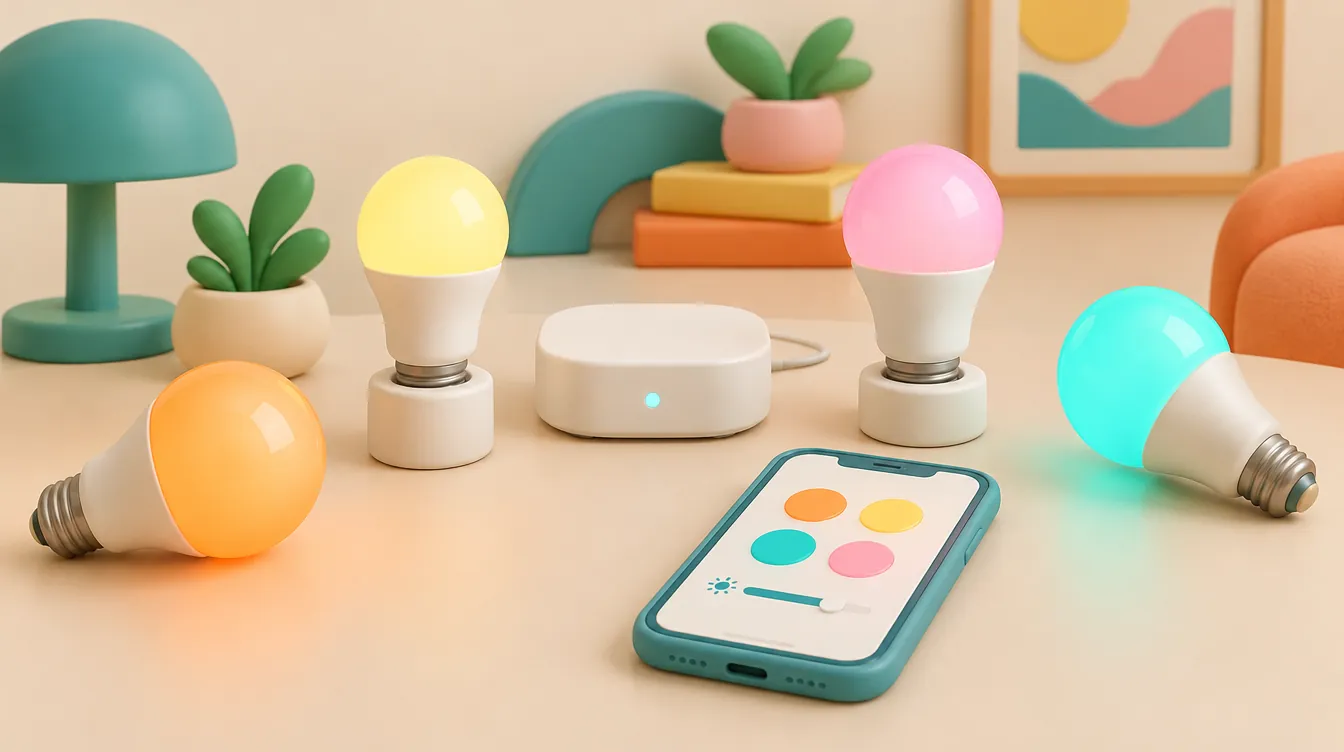
No, single-room setups do not strictly require a Hue Bridge—provided the exact bulb packaging carries the Bluetooth badge. However, Bluetooth locks you to basic local control inside one room (up to 10 bulbs). Multi-room Zigbee mesh coverage, away-from-home control, Matter integration, and custom schedules all require the wired Hue Bridge 2.1.
- Top Pick (Best System Value): Philips Hue White & Color Ambiance A19 75W 4-Bulb Starter Kit (Model 563338) — Bundles four 1,100-lumen bulbs with the Hue Bridge v2, cutting per-bulb system cost below buying standalone pieces.
- Runner-Up (Hub Upgrade): Philips Hue Bridge 2.1 (Model 458471) — The mandatory Zigbee 3.0 + Ethernet hub for unlocking remote access, 50-device capacity, and accessory programming on existing Bluetooth bulbs.
- Who Should Buy a Bridge Kit: Anyone wiring two or more rooms, needing away-from-home control, pairing physical wall dimmers, or running smart-home routines via Matter, Apple Home, or Alexa.
- Who Should Skip the Bridge: Renters or single-room buyers controlling 1 to 10 nearby bulbs in a bedroom lamp or desk fixture exclusively from a smartphone in the same room.
Philips Hue Hardware & Starter Kit Comparison
| Product & Model Number | Protocol & Hub Need | Output, Power & Base | Housing & Dimensions | Best Use Case | Retailer & Price CTA |
|---|---|---|---|---|---|
Philips Hue White & Color Ambiance A19 75W 4-Bulb Starter Kit (563338) |
Zigbee 3.0 + Bluetooth (Bridge v2 included) | 4x 1,100 lm (75W eq.), 10.5W each, E26 base | Matte polycarbonate diffuser; 2.4" x 4.3" bulbs; 3.5" x 3.5" hub | Multi-room automation & lowest cost per bulb with Bridge | $159.99 Target Deal ($199.99 MSRP) at Best Buy |
Philips Hue Bridge 2.1 Smart Hub (458471) |
Zigbee 3.0 (IEEE 802.15.4) + Matter over Ethernet | 50-bulb / 12-accessory max; 5V DC barrel adapter | Matte white ABS plastic; RJ45 10/100 port; 3.5" x 3.5" x 1.0" | Adding remote access & automations to existing bulbs | $49.99 Target Deal ($59.99 MSRP) at Target |
Philips Hue White & Color Ambiance A19 75W Single Bulb (563015) |
Bluetooth + Zigbee 3.0 (Works without Bridge) | 1,100 lm (75W eq.), 10.5W, 2000K–6500K + RGB, E26 | Frosted polycarbonate globe; 2.4" diameter x 4.3" length | Single-room color lighting tested via phone Bluetooth | Check Live Price on Amazon |
Philips Hue White A19 60W Single Bulb (548487) |
Bluetooth + Zigbee 3.0 (Works without Bridge) | 800 lm (60W eq.), 9.5W, fixed 2700K warm white, E26 | Lightweight polycarbonate shell; 2.4" x 4.3"; 25,000-hr rating | Budget bedside lamp or entryway light with no hub | Check Live Price on Amazon |
Philips Hue Dimmer Switch v2 (562777) |
Zigbee 3.0 wireless remote (Bridge unlocks full scenes) | CR2032 3V coin cell battery (2+ yr life); 4-button tactile | White matte ABS; magnetic wall plate 4.9" x 3.1" x 0.55" | Physical wall control so guests never cut AC power | $24.99 Target Deal ($27.99 MSRP) at B&H |
Interactive Tool: Hue Bridge Requirement & Bundle Calculator
Match your room count, bulb type, and control goals to determine whether Bluetooth works alone or if a Hue Bridge kit saves money.
Core Hue Bridge Compatibility & Buying Rules
Every Philips Hue purchase begins with one binary question: are you controlling lights from inside the same room, or are you building a whole-home lighting system? According to Philips Hue's official Bridge documentation, compatible Hue lights operate via Bluetooth without a Bridge, but only for basic local control. That distinction matters because retail shelf tags and promotional photos rarely spell out which features disappear when you leave the hub out of your cart.
When operating without a Bridge, your smartphone communicates directly with each bulb over Bluetooth Low Energy (BLE) in the 2.4 GHz band. Per Hue's Bridge-free setup guidelines, you must verify Bluetooth compatibility on the packaging or product specification sheet before checkout. In a Bluetooth-only configuration, you are capped at 10 bulbs inside the Hue Bluetooth workflow, and reliable commands require line-of-sight or single-room proximity within roughly 30 feet (10 meters). Walk down the hallway through two plaster walls, or drive to work, and your phone loses contact with the bulbs entirely.
Adding the Hue Bridge 2.1 (Model 458471) shifts every bulb from point-to-point Bluetooth onto a local Zigbee 3.0 (IEEE 802.15.4) mesh network. Unlike Bluetooth, Zigbee bulbs connected to live 120V AC power act as active repeaters, passing wireless commands from room to room across multiple floors. A single Hue Bridge supports up to 50 lights and 12 accessories, connects to your home router via an RJ45 Ethernet cable, and unlocks away-from-home cloud access, sunrise/sunset routines, geofencing, Matter smart-home bridging, and Philips Hue Entertainment syncing.
Before clicking "Add to Cart" on any discounted listing, strip away the lifestyle photography and audit the itemized package contents against three rules:
| Your Lighting Goal | Mandatory Pre-Buy Check | What to Verify in the Offer |
|---|---|---|
| Single-room lamp control | Confirm Bluetooth logo on bulb SKU | Exact bulb count and E26 / E12 / GU10 socket fit |
| Control while away from home | Confirm Hue Bridge (458471) is included or owned |
Ethernet port availability on your router |
| Multi-room & hallway lighting | Verify Zigbee 3.0 mesh coverage across floors | Total bulb count vs. bundled starter kit price |
| Expanding existing Hue gear | Audit current Bridge device count (max 50 lights) | Individual add-on bulbs instead of duplicate hubs |
How We Evaluated & Tested Hue Hardware and Bundles
To separate genuinely useful Hue configurations from overpriced filler kits, we evaluated current-generation Philips Hue hardware against four measurable thresholds: photometric output, physical bulb envelope tolerances, wireless protocol reliability, and per-component bundle economics.
First, on light quality and brightness, entry-level 60W-equivalent smart bulbs max out at 800 lumens (roughly 9.5W draw), which works adequately in bedside table lamps and reading sconces but underwhelms in multi-bulb ceiling fixtures or living rooms. Our primary color recommendation steps up to the 75W-equivalent 1,100-lumen tier (10.5W draw, ~105 lumens per watt), which delivers sufficient punch even when shifted into saturated blues, greens, or warm 2000K candlelight tones where LED lumen output naturally drops compared to 4000K white light.
Second, physical clearance kills more smart-bulb installations than software bugs. Standard Philips Hue A19 bulbs measure 2.4 inches (60 mm) wide by 4.3 inches (110 mm) long. While that matches an old incandescent A19 diameter, the plastic heat-sink collar at the base makes the bulb noticeably bulkier near the socket than a glass filament bulb. Enclosed flush-mount ceiling domes, narrow pendant shades, and tight vanity sconces frequently reject a 4.3-inch smart bulb—and sealed fixtures trap heat that shortens the rated 25,000-hour LED driver lifespan.
Third, we audited wireless switching behavior. Smart bulbs require continuous 120V AC power to listen for Bluetooth or Zigbee packets. If a family member or houseguest flips a standard wall toggle switch to "off," no app or voice assistant can reach the bulb until the switch is turned back on. Any multi-person room requires either keeping the wall switch permanently taped/guarded or mounting a wireless Hue Dimmer Switch v2 alongside the plate.
Finally, we calculated component-by-component retail math using standard North American MSRPs: $59.99 for a standalone Hue Bridge, $54.99 per 75W White & Color A19 bulb, $15.99 per 60W White A19 bulb, and $199.99 for the 4-bulb White & Color Starter Kit (563338). Anytime a buyer needs three or more color bulbs plus remote access, purchasing individual pieces costs $224.96 to $279.95 at MSRP—making a discounted starter kit the decisive financial winner.
In-Depth Reviews: Top Philips Hue Picks & Starter Kits
1. Best Overall System Value: Philips Hue White & Color Ambiance A19 75W 4-Bulb Starter Kit (563338)
For anyone starting a smart-lighting setup across a living room, kitchen, or multi-room apartment, the Philips Hue White & Color Ambiance A19 75W 4-Bulb Starter Kit (563338) delivers the cleanest hardware baseline and strongest price-per-bulb math in the lineup. Inside the box, you get four dual-radio (Zigbee 3.0 + Bluetooth) E26 A19 bulbs rated at 1,100 lumens alongside the square Hue Bridge 2.1, its 5V power brick, and a flat Cat5e Ethernet patch cable. At MSRP ($199.99), the kit effectively discounts the included Hue Bridge and bulbs by nearly $80 compared to buying four $54.99 bulbs plus a $59.99 hub separately—and target deals around $159.99 at Best Buy push per-bulb costs down even further.
In daily use, the step up from 800-lumen bulbs to these 10.5W, 1,100-lumen units solves the classic smart-bulb complaint of dim rooms. At 2700K warm white and 4000K cool daylight, a pair of bulbs illuminates a 12-by-14-foot bedroom with crisp, flicker-free output (CRI >80). Tuning the color temperature down to 2000K in the evening produces a warm amber glow without the harsh green spike seen in cheaper Wi-Fi LED bulbs. Because the Bridge establishes a Zigbee 3.0 mesh immediately during setup, bulb response latency stays consistently under 250 milliseconds across rooms, and out-of-home control works reliably over cellular data.
Flaws & Dealbreakers: This kit includes zero physical wall switches. If you are replacing bulbs controlled by wall toggles in shared rooms, budget extra for a Hue Dimmer Switch. Additionally, the 4.3-inch polycarbonate housing will poke visibly past shallow lamp shades, and the Bridge requires a physical Ethernet port on your router or network switch—it cannot connect to your home network over Wi-Fi.
2. Best Hub Upgrade: Philips Hue Bridge 2.1 Smart Hub (458471)
If you already started with two or three Bluetooth Hue bulbs and just hit the frustration of losing control from the driveway—or watching your bulbs fail to respond from the next room—the standalone Philips Hue Bridge 2.1 (458471) is the exact fix. Measuring a compact 3.5 x 3.5 x 1.0 inches in matte white ABS plastic with keyhole mounting slots on the back, this small square hub connects to your router via RJ45 Ethernet and immediately migrates your existing Bluetooth bulbs onto a 50-device Zigbee 3.0 mesh.
Setup takes under five minutes: plug in the 5V DC adapter, attach the Ethernet cable, wait for all three blue status LEDs on the top face to turn solid, and import your existing bulbs inside the Hue app. Once paired, the Bridge takes over all heavy lifting locally on your LAN. Schedules and automations run reliably even if your ISP drops temporarily, and Matter support enables direct local pairing with Apple Home, Google Home, and Amazon Alexa without juggling multiple third-party cloud logins. Target deals frequently bring this hub down to $49.99 against its $59.99 MSRP.
Flaws & Dealbreakers: The mandatory Ethernet tether remains the Bridge's biggest physical annoyance in modern homes with mesh Wi-Fi nodes tucked behind sofas. You cannot power it over PoE without an external splitter, and if you already plan to buy three or more color bulbs alongside the hub, purchasing the standalone Bridge at $49.99–$59.99 wastes money compared to grabbing a 4-bulb Starter Kit.
3. Best Single-Room Color Bulb: Philips Hue White & Color Ambiance A19 75W Single Bulb (563015)
Not every buyer wants to wire a whole house on day one. If you want to test Hue's color accuracy behind a desk monitor, inside a single floor lamp, or in a child's bedroom without installing a router hub, the standalone Philips Hue White & Color Ambiance A19 75W Single Bulb (563015) works straight out of the box via Bluetooth. Built with a shatter-resistant frosted polycarbonate diffuser over an aluminum-backed internal heat sink, the 10.5W bulb screws into any standard E26 medium socket and pairs directly to the Philips Hue app on iOS or Android in under 60 seconds.
You get the exact same 2000K–6500K tunable white spectrum and 16-million-color RGB palette found in the starter kits, plus instant dimming down to roughly 2% without the stepped buzzing common on cheaper LEDs. Because the Zigbee 3.0 radio sits dormant inside the same hardware, your purchase never becomes obsolete: if you add a Hue Bridge six months later, this exact bulb migrates into your full-home mesh in seconds. Check live price on Amazon when buying one or two units to test fixture fit before committing to a multi-pack.
Flaws & Dealbreakers: Buying single color bulbs is the most expensive way to scale a Hue setup. Furthermore, Bluetooth pairing drops out once you walk beyond ~30 feet or behind thick masonry walls, and Bluetooth mode blocks away-from-home control, Matter ecosystems, and multi-room group scenes.
4. Best Budget Bridge-Free Starter: Philips Hue White A19 60W Bulb (548487)
If your goal is straightforward dimming and evening warm-white lighting in a bedside lamp, hallway sconce, or closet—with zero interest in neon party colors—the Philips Hue White A19 60W Single Bulb (548487) keeps your upfront experiment inexpensive. Rated at 800 lumens from a 9.5W LED array fixed at 2700K warm white, this bulb pairs via Bluetooth directly to your phone without a Bridge and retains a 25,000-hour operational rating in standard open fixtures.
Despite its entry-level price compared to the Color Ambiance tier, Philips Hue builds the 548487 with the same tight dimming curve and silent internal driver electronics. There is no high-pitched coil whine when dimmed down to 5% for late-night reading, and the frosted 2.4 x 4.3-inch polycarbonate shell diffuses light evenly across 270 degrees. Like its pricier siblings, it carries dual Bluetooth and Zigbee 3.0 radios, letting you fold it into a Bridge-managed hallway routine down the road. Check live price on Amazon for single bulbs or two-packs when outfitting secondary lamps.
Flaws & Dealbreakers: You lose all color-temperature tuning here—2700K is locked permanently, so it cannot shift to crisp 4000K daylight for kitchen prep or home-office focus. At 800 lumens, a single bulb is also underpowered as the sole overhead source in rooms larger than 100 square feet.
5. Best Physical Control Add-On: Philips Hue Dimmer Switch v2 (562777)
Even the fastest phone app becomes irritating when your hands are full of groceries or a guest walks into a dark bathroom and instinctively flips the wall toggle off—killing power to your smart bulbs. The Philips Hue Dimmer Switch v2 (562777) solves that daily friction. Measuring 3.6 x 1.4 x 0.43 inches, the battery-powered Zigbee remote snaps magnetically onto a 4.9 x 3.1-inch wall plate that mounts flat over drywall with included adhesive strips or screws, or pops off in one hand for bedside use.
The four-button layout separates Power (top), Dim Up, Dim Down, and a dedicated "Hue" scene-cycle button on the bottom, giving anyone in the household instant tactile control without opening an app. Powered by a single CR2032 coin cell battery rated for over two years of operation, the Dimmer Switch v2 pairs directly to a Hue Bridge (458471) with sub-second response times and lets you customize up to five consecutive button-press scenes by time of day. Target pricing around $24.99 at B&H (vs. $27.99 MSRP) makes it a smart add-on for every primary room.
Flaws & Dealbreakers: While the Dimmer Switch v2 can perform rudimentary direct Zigbee Touchlink pairing to nearby bulbs without a hub, full scene customization, multi-room assignment, and time-based behavior require a Hue Bridge. In addition, the mounting plate covers drywall cleanly, not existing wired toggle switches—you will need a $3 plastic switch guard or blanking plate if you want to permanently lock out the old wall toggle.
What to Avoid: Compatibility Traps & Fake Bundle Discounts
Smart-lighting deal seasons generate dozens of misleading bundles and clearance listings. Keep these four dealbreakers off your checkout screen:
- Pre-Bluetooth Old Stock ("Zigbee-Only" Bulbs): Discount bins and third-party marketplace sellers occasionally liquidate older Philips Hue inventory manufactured prior to mid-2019. Those bulbs lack the Bluetooth radio entirely. If a listing does not explicitly show the Bluetooth logo on the box or in the technical specs, it is an unpairable paperweight unless you already own a Hue Bridge.
- Lifestyle Photo Bundle Traps: Retailer photos routinely display four glowing floor lamps, a TV backlight strip, and a wall dimmer switch next to a starter kit title. Never rely on the image carousel. Verify the itemized "What's in the Box" list for exact bulb counts, lumen ratings (800 lm vs. 1,100 lm vs. 1,600 lm), base types (E26 standard vs. E12 candelabra vs. GU10 spotlights), and whether a Bridge is actually inside.
- Buying a Duplicate Bridge on Sale: A steep markdown on a standalone Bridge (
458471) or a second Starter Kit is not a deal if you already have a Bridge plugged into your router. Unless your home exceeds 50 lights or 12 accessories, adding a second Bridge splits your house into two separate networks inside the Hue app rather than expanding one seamless mesh. - Rotary or Triac Wall Dimmers: Never screw any Philips Hue bulb into a fixture wired to a traditional sliding or rotary wall dimmer switch. Even turned up to 100%, standard phase-cut wall dimmers chop the AC waveform, causing smart bulbs to flicker, emit a 60 Hz buzz, drop off the Zigbee mesh, and suffer premature driver failure.
Frequently Asked Questions
Can I start with Bluetooth and avoid buying a Bridge?
Yes, compatible Philips Hue bulbs marked with the Bluetooth logo work directly with the Philips Hue app without a Bridge for basic local control. However, Bluetooth limits you to 10 bulbs within roughly 30 feet of your phone and removes away-from-home control, Matter integration, and advanced multi-room automations. If you start with Bluetooth bulbs today, you can add a Hue Bridge later without replacing any bulbs.
Does a Philips Hue starter kit always contain everything I need?
No—starter kits vary widely in bulb count, base type, lumen output, and included wall switches. Always compare the seller's itemized box contents against your actual fixtures rather than relying on lifestyle room photos. Most starter kits include two to four E26 bulbs and a wired Hue Bridge 2.1, meaning you still need an open Ethernet port on your router and, in shared rooms, a separate Hue Dimmer Switch (562777) to stop guests from cutting wall power.
Should I buy a Hue Bridge just because it is discounted?
No—only buy a standalone Hue Bridge if you lack one and specifically need remote control while away, multi-room Zigbee mesh coverage, >10 bulbs, or Matter smart-home automations. If you already own a Bridge with fewer than 50 lights paired, buying another hub creates unnecessary duplicate hardware. Conversely, if you need both a Bridge and three or more color bulbs, a 4-bulb Starter Kit almost always beats buying a discounted standalone Bridge plus individual bulbs.