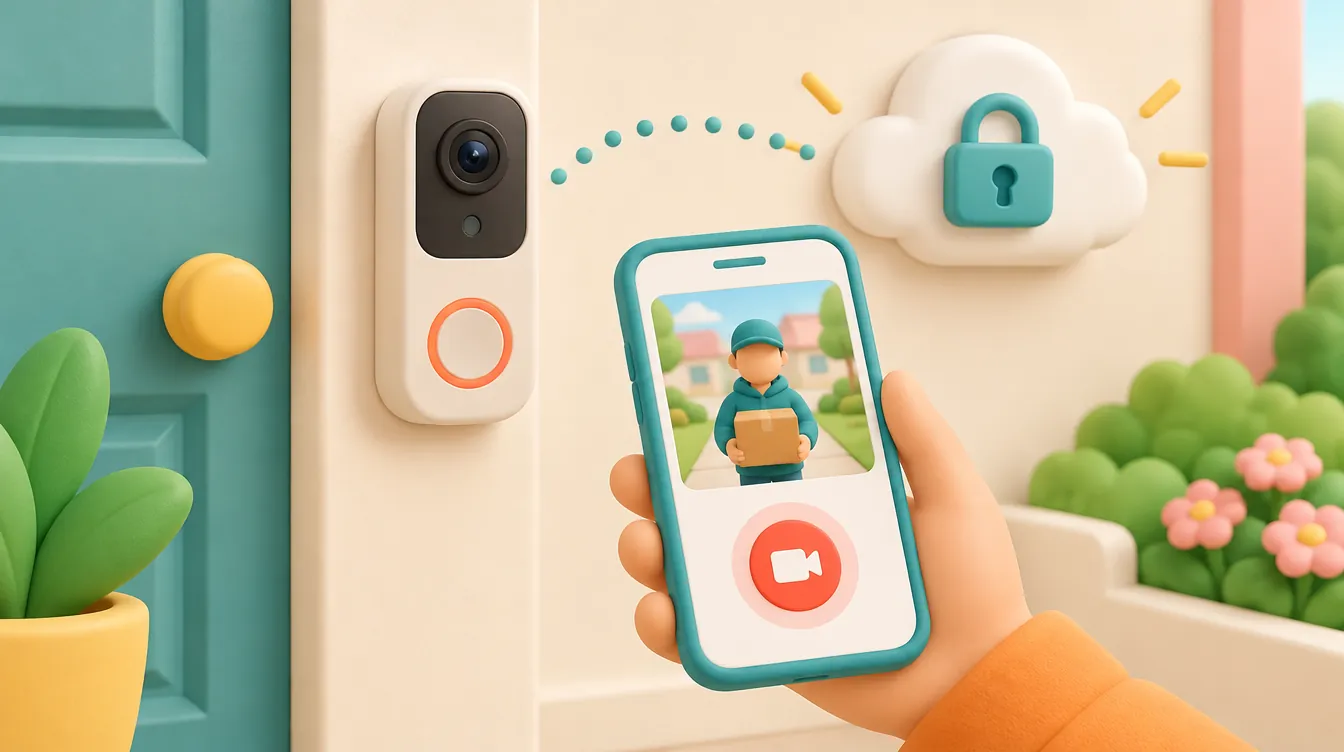
The Core Rule: A Ring doorbell streams real-time Live View and sends motion or ring notifications for free, but it does not save or let you replay recorded video clips without an active Ring subscription. Furthermore, subscribing after an incident will never recover earlier unrecorded events.
- Top Pick (Full Features + Plan Budgeted): Ring Battery Doorbell Pro — Combines 1536 × 1536 head-to-toe video, dual-band Wi-Fi, and 3D radar motion detection to prevent false alerts from clogging your paid cloud history.
- Runner-Up (Best Value Ring Doorbell): Ring Battery Doorbell (2024 Release) — Offers 1440 × 1440 square video and USB-C charging at a lower hardware cost, keeping your multi-year total budget low on a single-device plan.
- Who Should Buy a Ring Doorbell: Households that want immediate smartphone alerts, two-way talk, and Alexa integration, and either only need live visitor interaction or accept budgeting for an ongoing cloud plan to keep video history.
- Who Should Skip It: Buyers who refuse recurring monthly fees yet still require saved package or security clips—choose a local-storage doorbell such as the Eufy Security Video Doorbell E340 (T8214) instead.
Top Video Doorbells Compared by Recording Requirements and Hardware Specs
| Model & Exact Designation | Resolution & Field of View | Power & Connectivity Specs | Build & Dimensions | Best Use Case | Retailer & Price CTA |
|---|---|---|---|---|---|
| Ring Battery Doorbell Pro (2024 Release) | 1536 × 1536 HD+, 150° H × 150° V | Quick-Release Battery or 8–24 VAC hardwire; Dual-band 2.4/5 GHz Wi-Fi | 5.04" × 2.44" × 1.10", polycarbonate, 3D radar sensor | Busy porches needing radar zone filtering with a Ring plan | Check Live Price on Amazon |
| Ring Battery Doorbell (2024 Release) | 1440 × 1440 HD+, 150° H × 150° V | Built-in USB-C rechargeable battery or 8–24 VAC; 2.4 GHz Wi-Fi | 4.98" × 2.44" × 0.91", pin-release mounting plate | Renters & single-door budgets prioritizing low upfront cost | $79.99 Target Deal (MSRP $99.99) at Best Buy |
| Ring Wired Doorbell Pro (Pro 2) | 1536 × 1536 HD+, 150° H × 150° V | Hardwired 16–24 VAC (10–40 VA); Dual-band 2.4/5 GHz Wi-Fi | 4.49" × 1.90" × 0.87", includes Pro Power Kit v3 | Wired homes wanting zero battery swaps & Pre-Roll clips | Check Live Price on Amazon |
| Ring Video Doorbell Wired (Gen 1) | 1080p HD (16:9), 155° H × 90° V | Hardwired 16–24 VAC (10–40 VA); 2.4 GHz Wi-Fi (no mechanical chime) | 3.98" × 1.81" × 0.88", matte polycarbonate chassis | Low-cost live-view setups or single-device Ring plans | $49.99 Target Deal (MSRP $64.99) at Target |
| Eufy Video Doorbell E340 (Model T8214) | Dual Cam: 2K (2048 × 1536) + 1080p down | 6,500 mAh removable battery or 8–24 VAC; 2.4 GHz Wi-Fi | 5.90" × 2.00" × 1.10", IP65 weather rating, 8 GB eMMC | Buyers wanting saved local clips with zero monthly fees | Check Live Price on Amazon |
Interactive Tool: Ring Subscription & Total Cost of Ownership Calculator
Use this calculator to check whether your intended setup requires a paid Ring plan, avoid underestimating renewal costs after an introductory trial expires, and calculate your true multi-year expenditure before clicking buy. Enter your own current Ring plan rate from checkout so your renewal math matches active US pricing.
Ring Recording Eligibility & 3-to-5 Year Cost Estimator
Select how you plan to use the doorbell and adjust hardware or renewal inputs to compare upfront discounts against ongoing subscription totals.
Ring Subscription Requirements: Separating Live Viewing From Saved Video History
Buying a video doorbell starts with a strict technical distinction: watching your front porch in real time is completely separate from reviewing what happened twenty minutes ago. According to Ring's official product FAQ, real-time viewing (Live View), two-way talk, and instant smartphone notifications when someone presses the button or triggers motion are available without paying a monthly fee. You can mount the hardware, connect it to your home router, answer a courier from your desk, and never enter a credit card for cloud storage.
The paywall begins the moment you want recorded history. Per Ring's subscription documentation, reviewing, saving, or sharing recorded video from a Ring doorbell or security camera requires an active, compatible Ring subscription. Without a plan, a Ring doorbell has no internal microSD card slot and no built-in flash memory buffer for consumer clip playback. If you miss a motion alert while driving or sleeping, opening the Ring app later will not produce a playable video clip of who approached your door.
Equally critical is Ring's non-retroactive recording rule. Ring explicitly states that video recording begins only after a subscription becomes active; earlier unrecorded events cannot be recovered by subscribing after an incident occurs. Many new owners are caught off guard because the Ring app can still log a timestamped motion or ring notification in an event history list, creating the false impression that playable video exists somewhere on Ring's servers waiting to be unlocked. An entry in a text log does not mean video was captured. If reviewing package deliveries, vandalism, or missed visitors after the fact is central to why you are buying a doorbell, you must arrange and budget for the recording plan from day one.
Aligning Plan Scope, Trials, and Household Ownership
Before comparing hardware discounts, map your exact household layout against Ring's plan structure. Ring separates single-device coverage from multi-device location coverage, and certain advanced software features—such as extended cloud retention windows, person or package alert filtering, or multi-camera automation—depend on both your chosen plan tier and the specific doorbell model's eligibility. Never treat a single-device plan price as equivalent to a whole-home plan if you anticipate adding a driveway floodlight cam or backyard stick-up cam within the next year.
Retailers and Ring frequently bundle hardware with an introductory free trial, which masks the long-term financial commitment during the return window. During a 30-day trial, features like saved video playback, rich notification snapshots, and smart alerts operate seamlessly. Once that promotional window closes, those capabilities vanish unless you transition to a paid renewal. Treat the trial strictly as an evaluation period and benchmark your purchase using the post-trial renewal rate you intend to keep over three to five years. Add the doorbell price, any required mounting wedge or transformer upgrades, and multi-year subscription renewals together before deciding whether a discounted Ring kit beats a standalone alternative.
If you are purchasing a doorbell as a gift, resolve the recurring fee question before selecting a model. Some recipients gladly pay an annual cloud fee for off-site backup and simple app playback, while others resent receiving hardware that loses its primary security function unless they adopt a new monthly bill. Confirm who will own the primary Ring account, who receives shared access to download important clips, and how long clips must be retained before automatic deletion. Because detection reliability also depends heavily on Wi-Fi signal strength through exterior walls and local motion sensitivity, no camera system—paid or unpaid—can guarantee that every single passing event will be captured.
How We Evaluated Doorbell Hardware and Plan Compatibility
To isolate which doorbells deliver reliable value under Ring's subscription framework—and which alternative makes sense when you refuse ongoing fees—we evaluated candidates across five measurable hardware and policy thresholds:
- Field of View & Vertical Framing (Aspect Ratio): Traditional 16:9 widescreen doorbells (typically 155° horizontal by 90° vertical) frequently cut off the porch floor right beneath the lens, hiding packages from view. We prioritized 1:1 square aspect ratio sensors (1440 × 1440 or 1536 × 1536 resolution with 150° × 150° coverage) or dedicated dual-camera downward lenses so you can see both a visitor's face and boxes placed against the threshold.
- Power Architecture & Transformer Tolerances: Battery-only installations simplify renter setups but introduce charging downtime and delayed wake-from-sleep recording, which can miss the first few seconds of a fast-moving delivery driver. For hardwired models, we verified compatibility against standard North American doorbell transformers rated at 16–24 VAC and 10–40 VA. Low-power 8–10 VA legacy transformers frequently cause Wi-Fi dropouts or reboot loops when a doorbell's infrared LEDs and chime solenoid fire simultaneously.
- Wi-Fi Band Support & Exterior Wall Attenuation: Entryways built with brick, stucco, metal storm doors, or stucco wire lath severely degrade wireless throughput. While 2.4 GHz Wi-Fi travels farther through dense exterior walls, congested neighborhood channels cause Live View stalls. We checked for dual-band 2.4 GHz and 5 GHz radio support on higher-tier models to stabilize high-bitrate 1536p streams near mesh nodes.
- Motion Filtering Precision (PIR vs. 3D Radar): On a paid cloud plan, false alerts from waving tree branches or passing cars clutter your timeline and drain battery reserves. We distinguished basic Passive Infrared (PIR) heat sensors from 3D millimeter-wave radar doorbells that measure actual distance thresholds in feet before waking the camera.
- Local Backup vs. Cloud Lock-In: We audited whether each device forces cloud-only video storage or includes onboard non-volatile flash memory (such as 8 GB eMMC) capable of retaining weeks of encrypted events locally without a subscription.
In-Depth Doorbell Reviews
1. Ring Battery Doorbell Pro (2024 Release) — Top Pick for Most Ring Households
The Ring Battery Doorbell Pro is the most capable battery-powered model in Ring's lineup and the smartest choice if you already plan to maintain a Ring subscription. Measuring 5.04" × 2.44" × 1.10", its polycarbonate chassis houses a 1536 × 1536 HD+ camera sensor delivering a 150° horizontal by 150° vertical field of view. Unlike older 16:9 battery doorbells that force you to choose between seeing a tall courier's face or packages on the doormat, the 1:1 square frame captures both simultaneously in sharp detail, aided by full-color night vision when ambient porch lighting is present.
Where the Battery Doorbell Pro separates itself from Ring's entry-level models is its 3D Motion Detection radar and dual-band Wi-Fi (2.4 GHz and 5 GHz) radio. Standard PIR sensors react to sudden heat shifts, which frequently triggers unnecessary motion alerts from passing vehicle headlights or sunlit sidewalks. By mapping distance in feet using radar, the Pro lets you draw tight detection boundaries—stopping alerts right at your porch steps—so your paid cloud timeline stays focused on genuine visitors rather than street traffic. It also introduces Bird's Eye View, stitching an aerial path overlay onto your recorded clips when a compatible plan is active.
Power comes from a Quick-Release Battery Pack sliding out of the bottom compartment, allowing you to swap in a spare charged cell in thirty seconds without unmounting the unit, or connect it to 8–24 VAC existing wiring for trickle charging. The main flaw is price-to-subscription stacking: this is an expensive doorbell upfront, and locking out its radar-assisted clip history, Bird's Eye View recordings, and Pre-Roll-style context without a paid plan makes little sense if you only intend to use free Live View.
2. Ring Battery Doorbell (2024 Release) — Runner-Up for Budget Ring Setups
If you want Ring's updated head-to-toe framing without paying flagship hardware pricing on top of your subscription, the Ring Battery Doorbell (2024 Release) hits the cleanest cost balance. Shaving the footprint down to 4.98" × 2.44" × 0.91", this model upgrades Ring's entry battery tier to 1440 × 1440 HD+ resolution with a 150° × 150° field of view. For renters, apartment doors, or homeowners budgeting strictly for a single-device plan, keeping upfront hardware cost down helps offset three to five years of software renewals.
In daily use, the 2024 Battery Doorbell delivers reliable two-way talk, fast push notifications for live answers, and clear daytime package visibility right down to the threshold. Because it supports 8–24 VAC hardwiring in addition to battery operation, buyers moving from a rental into a wired house can carry the same device with them and maintain trickle power. Its wireless chip is limited to 2.4 GHz Wi-Fi, which penetrates drywall well over longer distances, though congested apartment complexes may experience slightly slower Live View handshakes than dual-band Pro units.
The primary hardware compromise is its non-removable built-in battery. Unlike the Quick-Release Battery Pack used on the Pro and Plus models, charging the 2024 Battery Doorbell requires releasing the security pin at the base, pulling the entire doorbell off its mounting bracket, and plugging it into a USB-C cable indoors for several hours. While the doorbell sits on your kitchen counter recharging, your front door has zero camera coverage—a notable inconvenience if you rely on continuous subscription protection.
3. Ring Wired Doorbell Pro (Pro 2) — Best Hardwired Ring Option
Homes equipped with functional 16–24 VAC (10–40 VA) doorbell wiring get superior responsiveness and a slimmer profile from the Ring Wired Doorbell Pro (originally launched as the Video Doorbell Pro 2). Measuring just 4.49" × 1.90" × 0.87", its narrow housing fits comfortably on tight brick molding and narrow door trim where wider battery models overhang awkwardly. Inside, it packs the same 1536 × 1536 HD+ (150° × 150°) square sensor, 3D radar motion detection, and dual-band 2.4/5 GHz Wi-Fi found on the Battery Pro, but draws continuous AC power instead of rationing a lithium cell.
Continuous AC power unlocks Pre-Roll, one of Ring's most practical hardware advantages when paired with an active recording plan. Because the camera buffers low-power video continuously in memory, saved motion clips include up to six seconds of footage before the motion trigger fired—capturing a delivery driver walking up the driveway rather than just their back as they turn to leave. Without an active subscription, however, Pre-Roll clips cannot be archived or reviewed later, leaving only real-time Live View.
Installation requires more electrical diligence than a battery doorbell. You must install the included Pro Power Kit across your indoor mechanical chime terminals to regulate current, and older homes running weak 8–10 VA transformers will experience random reboots or sluggish chime strikes until the transformer is upgraded to 16–24 VAC, 30–40 VA. If your wiring is dead or nonexistent, skip this model entirely.
4. Ring Video Doorbell Wired (Gen 1) — Ultra-Budget Entry With a Major Chime Catch
Positioned as Ring's lowest-priced hardwired model, the Ring Video Doorbell Wired trims dimensions to 3.98" × 1.81" × 0.88" and strips away radar, square framing, and battery packs. It records at 1080p HD in a wide 16:9 aspect ratio (155° horizontal × 90° vertical) over 2.4 GHz Wi-Fi, powered strictly by 16–24 VAC (10–40 VA) wiring. For shoppers seeking a rock-bottom entry price strictly to answer visitors live from their phone—or to keep first-year expenses minimal alongside a single-device subscription—its small matte-black housing blends neatly into almost any doorframe.
However, the Video Doorbell Wired carries two severe compromises that catch budget shoppers off guard. First, its narrow 90° vertical field of view creates a tall blind spot right below the camera; unless you mount an angled wedge kit tilting the lens downward, packages placed close to your threshold frequently vanish out of frame. Second—and far more disruptive—the Ring Video Doorbell Wired cannot ring your home's existing indoor mechanical or digital chime. Installation requires bypassing your indoor chime terminals using a jumper cable included in the box. Unless your household relies exclusively on smartphone notifications, an Amazon Echo speaker, or a separate Ring Chime plug-in accessory (which adds extra upfront cost), nobody inside the house will hear the doorbell ring if your phone is muted.
5. Eufy Security Video Doorbell E340 (Model T8214) — Best Subscription-Free Alternative
If reviewing Ring's subscription rules confirms that you do not want a permanent monthly bill just to replay yesterday's porch activity, the Eufy Security Video Doorbell E340 (Model T8214) solves the problem at the hardware level. Rather than locking clip playback behind a cloud paywall, the E340 embeds 8 GB of encrypted eMMC local storage directly inside the doorbell, retaining roughly 60 days of motion-triggered event clips with $0 monthly subscription fees. Even without paying a cent after purchase, you can open the app hours or weeks later, scrub through saved recordings, and download clips straight to your phone.
On optical hardware, the E340 outspecs single-lens competitors by mounting two separate cameras: a 2K (2048 × 1536) forward-facing sensor for visitors and a dedicated 1080p downward-angled camera aimed directly at the doormat to eliminate package blind spots. It includes dual front LED spotlights for full-color night vision, an IP65 weather-resistant shell measuring 5.90" × 2.00" × 1.10", and flexible power via either a removable 6,500 mAh quick-release battery or 8–24 VAC hardwiring.
Its trade-offs are physical size and theft vulnerability if unplugged from cloud storage. At nearly six inches tall, the E340 looks noticeably bulkier than Ring's slim wired units, and it connects solely on 2.4 GHz Wi-Fi. More importantly, because recordings live inside the doorbell's 8 GB memory (unless paired separately with a HomeBase indoor hub), a thief who physically rips the doorbell off the wall takes the stored footage with them—whereas Ring's paid cloud model keeps clips safely off-site.
What to Avoid: Fake Bundle Discounts, Wiring Traps, and Compatibility Pitfalls
Hardware promotions around smart doorbells frequently obscure ongoing software expenses and electrical incompatibilities. Avoid these four costly mistakes before ordering:
- Treating Hardware + Trial Bundles as Permanent Free Recording: Retailers routinely discount a Ring doorbell bundled with a Ring Chime or a 3-month trial and advertise it as a complete security package. Once the trial expires, clip saving stops immediately. Always calculate your three-to-five-year renewal cost using current plan pricing alongside any standalone hardware discount rather than comparing a promotional bundle against an unbundled alternative as if both offer identical ongoing value.
- Subscribing After an Incident Hoping to Unlock Old Footage: Never leave a Ring doorbell unsubscribed on the assumption that you can pay for one month only when a package goes missing. Ring does not buffer or archive unsubscribed motion video on its servers. Events shown in an unpaid history feed represent text or alert timestamps only—not hidden video files.
- Installing Hardwired Ring Doorbells on 8–10 VA Transformers: Older homes built before the 1990s frequently hide low-output 10 VAC / 5–10 VA chime transformers inside closets or basement joists. Connecting a Ring Wired Doorbell Pro or Video Doorbell Wired to an underpowered transformer causes voltage drops during chime strikes or night-vision surges, resulting in missed motion alerts and offline errors. Verify your transformer outputs 16–24 VAC and at least 10–40 VA before buying a wired-only model.
- Buying the Ring Video Doorbell Wired Expecting Indoor Chime Support: Because the entry-level Video Doorbell Wired bypasses your wall chime permanently with a jumper cable, budget buyers often spend extra immediately after installation buying a plug-in Ring Chime just to hear visitors indoors—erasing most of the price gap between it and better-equipped models.
Frequently Asked Questions
Can I use a Ring doorbell without paying monthly?
Ring confirms in its official support FAQ that you can view real-time Live View video and answer doorbell or motion notifications without a paid subscription. That setup works well if your sole priority is speaking with visitors while they are standing at your door. However, you should evaluate the unpaid experience separately from paid features shown during a trial or store demo, because no recorded clips are saved for later playback without an active plan.
Can I subscribe after an incident to recover its video?
No—do not rely on subscribing retroactively. Ring explicitly states that video recording begins only after a subscription is active, and earlier unrecorded events cannot be recovered by signing up later. Even if a missed ring or motion alert appears in your app's event timeline, that log entry does not mean playable video exists on Ring's servers. If reviewing past activity is important to your household, activate a compatible plan from day one.
How should I compare a discounted bundle with a standalone doorbell?
Break each offer down into separate line items: the doorbell itself, any included chimes or mounting accessories, the length of any introductory trial, and the ongoing renewal price for the plan tier your device count requires. Calculate the full three-year or five-year cost using current renewal terms after the trial ends, and compare matching doorbell models and coverage scopes directly so a short-term hardware discount does not hide a higher long-term subscription bill.