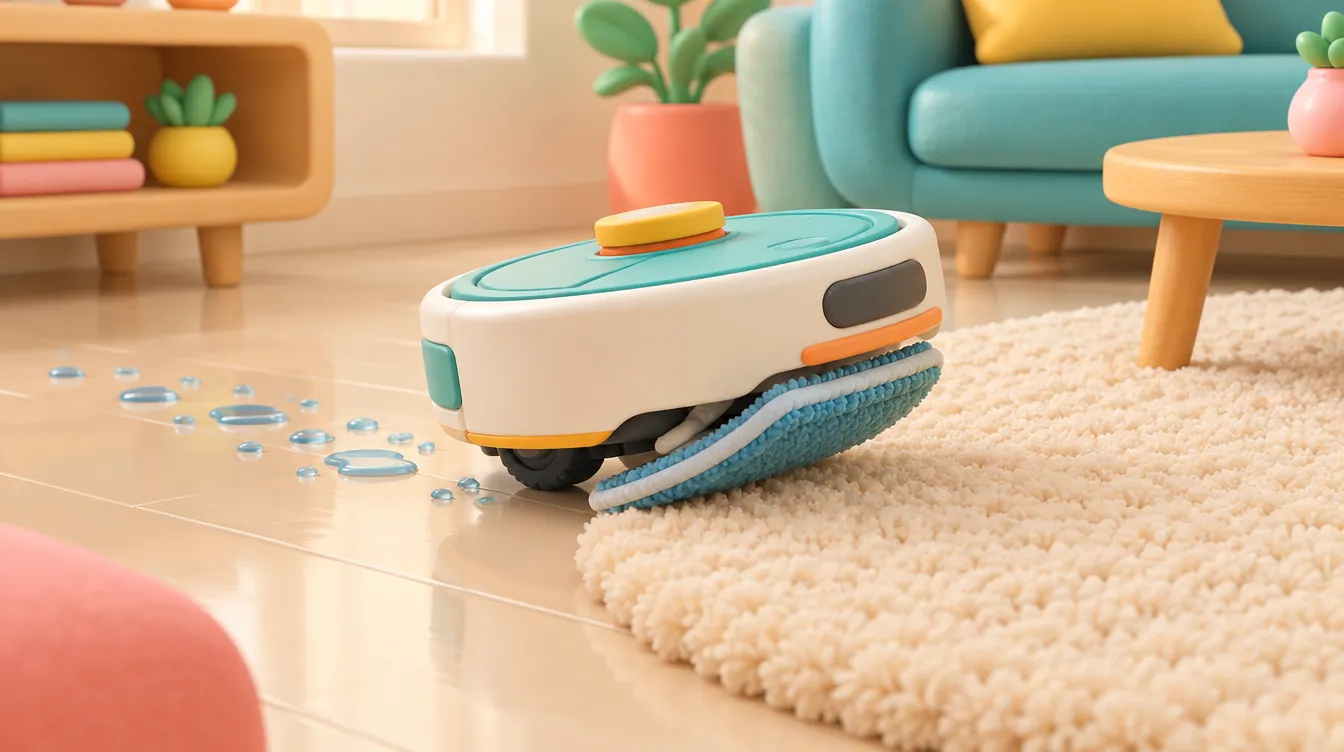
Top Pick for Plush & High-Value Rugs: iRobot Roomba Combo j7+ (Model C755020) — Its articulated mop arm physically retracts the wet pad onto the top shell of the robot, eliminating downward pad drag over medium- and high-pile rugs.
Runner-Up for Mixed Hard Floors & Low-Pile Rugs: Roborock S8 MaxV Ultra (Model S8MVU52-00) — Pairs a 20 mm VibraRise 3.0 mop lift with four granular Carpet Avoidance Modes, including Carpet Crossing for carpeted hallways separating hard-floor rooms.
Who Should Buy It: Households with open hard-floor zones interrupted by area rugs or carpeted thresholds who verify exact mop-lift clearance (in millimeters) and app routing modes before running unattended cycles.
Who Should Skip It: Mostly carpeted homes with only small bathroom or kitchen hard-floor patches, or owners of delicate silk, antique wool, or high-shag rugs over 15 mm thick who refuse to set strict No-Mop Zones or swap dry bins manually.
Top Robot Vacuum and Mop Models Compared for Carpet Protection
| Model & Exact Model Number | Mop Mechanism & Clearance | Suction, Dimensions & Sensor Tech | Best Floor-Plan Use Case | Retailer & Price CTA |
|---|---|---|---|---|
iRobot Roomba Combo j7+ (C755020) |
Full overhead retraction onto top chassis (zero underside wet-pad overhang) | 13.3 × 13.3 × 3.4 in; PrecisionVision AI camera + ultrasonic rug detection; Clean Base auto-empty | Homes with medium- to high-pile rugs (10–20 mm+) where underside mop lifts still graze fibers | Best Buy — $599.99 Target Deal ($999.99 MSRP) |
Roborock S8 MaxV Ultra (S8MVU52-00) |
VibraRise 3.0 sonic pad with 20 mm vertical auto-lift + 4 Carpet Modes | 10,000 Pa rated suction; 13.9 × 13.8 × 4.05 in; PreciSense LiDAR + Reactive AI 2.0 + ultrasonic sensor | Large mixed-floor homes needing Carpet Crossing over hallways and automated hot-water pad washing | Check Live Price on Amazon |
Roborock Qrevo S (QREVOS52-00) |
Dual 200 RPM spinning pads with 10 mm vertical auto-lift + 4 Carpet Modes | 7,000 Pa rated suction; 13.9 × 13.8 × 3.8 in; PreciSense LiDAR + ultrasonic carpet sensor; warm-air dry dock | Hard-floor homes with flatweave or low-pile rugs under 8 mm thick seeking lower dock maintenance | Best Buy — $599.99 Target Deal ($799.99 MSRP) |
eufy X10 Pro Omni (T2351111) |
Dual pentagonal spinning pads with 12 mm vertical auto-lift + app avoidance | 8,000 Pa rated suction; 13.9 × 12.9 × 4.47 in; iPath LiDAR + AI.See obstacle avoidance; 45 °C heated dock | Mid-budget mixed hard floors and low-pile rugs (under 10 mm) needing strong edge-pressure mopping | Check Live Price on Amazon |
iRobot Roomba Combo i5+ (i557020) |
Swappable hardware bin (dry vacuum bin vs. wet mopping bin; 0 mm lift when wet bin installed) | 13.4 × 13.4 × 3.6 in; floor-tracking navigation; Clean Base auto-empty for dry bin | Budget buyers willing to swap bins manually so wet pads never physically enter the robot during rug runs | Walmart — $349.00 Target Deal ($549.99 MSRP) |
Interactive Floor-Plan & Carpet Mode Compatibility Checker
Use this calculator to match your rug pile height, room layout, and maintenance tolerance to the correct mop-protection mechanism and app setting before ordering.
Rug Clearance & Carpet-Mode Match Tool
Select your thickest rug along the cleaning path and how your rooms connect to verify whether lifting, retracting, crossing, or avoidance is required.
Core Carpet Protection Rules: Lifting vs. Retracting vs. Crossing vs. Avoiding
Buying a robot vacuum and mop solely because the product listing promises "automatic carpet detection" is the fastest way to end up with damp rug borders. Carpet detection is only the trigger—an ultrasonic transducer on the underside of the chassis noticing soft acoustic absorption instead of hard tile or wood reflection. What happens in the half-second after detection varies dramatically across brands, hardware revisions, and app toggles.
According to Roborock's official Carpet Avoidance Modes guide, a single robot can execute four completely distinct behaviors depending on the setting you choose in the app:
- Carpet Rise (Lift & Vacuum): When the ultrasonic sensor detects carpet, the robot lifts its mop assembly vertically—by 10 mm on models like the Qrevo S (
QREVOS52-00) or up to 20 mm on the S8 MaxV Ultra (S8MVU52-00)—stops water dispensing, increases suction, and vacuums the rug. - Carpet Avoidance (Avoid): The robot treats detected carpet as a hard boundary during wet or combined cycles and drives around it completely. It never mounts the rug, which protects thick or delicate fibers but prevents the robot from vacuuming that rug during the same run.
- Carpet Crossing (Cross): Designed specifically for floor plans where a carpeted hallway separates two hard-floor rooms, Crossing instructs the robot to lift its mop, shut down mopping and main brushing, and drive across the carpet solely as a transit bridge to reach the next hard floor.
- Ignore: The robot runs right over the mapped area as if it were tile or hardwood. This exists strictly for waterproof outdoor mats, vinyl runners, or sessions where mop pads have been physically removed.
By contrast, iRobot's official specification for the Roomba Combo j7+ (C755020) takes an entirely different mechanical route. Rather than suspending a wet microfiber pad 10 mm or 20 mm beneath the belly of the robot where tall rug fibers can still wick moisture, the Combo j7+ swings its hinged mop arm up and over the rear bumper, resting the pad face-up on top of the robot's shell. That eliminates underside pad overhang altogether.
| Documented Behavior | Mechanical Action | Best Floor-Plan Scenario | Critical Limitation to Check |
|---|---|---|---|
| Vertical Mop Lift | Pad rises 10–20 mm under chassis | Low-pile rugs (under 8–12 mm) along mixed routes | Any rug thicker than the net clearance under the lifted pad still touches wet fabric |
| Overhead Retraction | Hinged arm moves pad onto robot's top | Medium- to high-pile rugs (10–20 mm+) | Larger vertical arm movement requires watching low-clearance furniture overhangs |
| Carpet Avoidance | Robot stays completely off detected rugs | Isolated area rugs inside hard-floor rooms | Blocks transit if carpet spans a narrow doorway or hallway between two kitchens/baths |
| Carpet Crossing | Robot traverses carpet without cleaning it | Carpeted corridors linking separate hard-floor zones | Relies on vertical lift height clearing the hallway carpet pile during transit |
Before clicking buy—whether you are comparing Best Buy offers or checking manufacturer spec sheets—walk your home's cleaning path at floor level. Sketch every room you expect cleaned in a single automated run and note three physical realities: the location of the dock (never place a wet-pad washing dock on plush carpet if possible), the exact pile height of rugs sitting along doorways, and whether a carpeted corridor blocks access to a bathroom or dining room. Do not assume a setting advertised on a brand's flagship model exists on its budget sibling; always verify the exact model number's manual before purchasing.
How We Evaluated Documented Clearance & Routing Standards
Because household rugs vary wildly in backing stiffness, fiber density, edge binding, and sub-pad thickness, we did not rely on vague marketing claims about "smart rug protection." We have not run independent wet-carpet laboratory stain or moisture-transfer tests across every household rug combination, so our recommendations evaluate documented mechanical designs, manufacturer mode manuals, chassis geometry, and vertical clearance math rather than guaranteeing dry carpets under every possible rug condition.
Our evaluation weights four concrete hardware and software thresholds:
- Net Lift vs. Effective Rug Height: A advertised 10 mm mop lift does not mean safe clearance on a 10 mm rug. A saturated microfiber pad measures roughly 3–5 mm thick, and the robot's drive wheels sink 2–4 mm into soft carpet backing. Once wheel sink and pad thickness are factored in, a 10 mm lift leaves barely 3–6 mm of real air gap—safe for flatweaves, risky for plush medium pile. Models offering 20 mm lifts (like the
S8MVU52-00) or top-mounted overhead retraction (like theC755020) establish the wide safety margin needed for thicker pile. - Route Continuity Controls: If your dining room and foyer are separated by a carpeted living room, a robot that only supports "Carpet Avoidance" will leave one of those hard-floor rooms unmopped. We prioritized platforms documenting explicit Carpet Crossing or selective room-order routing so users do not trap their robot behind an artificial wall of carpet.
- Ultrasonic + Visual Sensor Redundancy: Ultrasonic sensors read surface texture directly underneath the front caster, firing milliseconds before the rear mop pad reaches the rug edge. Models pairing downward ultrasonic sensors with forward AI cameras (
C755020,S8MVU52-00,T2351111) handle dark-colored rugs and irregular rug shapes more reliably than older bump-and-infrared bots. - Manual Overhead & Pre-Run Prep: High automation only pays off if you are not spending ten minutes flipping up rug fringes or swapping plates daily. We evaluated dock footprints, auto-empty intervals, heated pad drying (which prevents damp mildew between runs), and whether manual bin swaps make more financial sense for carpet-heavy layouts.
In-Depth Reviews: The Best Robot Vacuums and Mops for Protecting Carpets
1. iRobot Roomba Combo j7+ (C755020) — Best for Medium- and High-Pile Rugs
If your home features plush area rugs, thick wool runners, or uneven transitions where an underside mop lift still risks brushing damp fabric against carpet tufts, the iRobot Roomba Combo j7+ (C755020) solves the problem mechanically rather than relying on millimeters of vertical travel. Instead of hovering a wet pad beneath its undercarriage, the C755020 uses a motorized, twin-arm hinge that lifts the entire mop plate clear of the rear bumper and parks it upside down on top of the robot's chassis. When the pad is retracted overhead, nothing wet exists anywhere under the robot.
Measuring 13.3 inches in diameter and 3.4 inches tall, the Combo j7+ fits under lower sofa skirts and toe-kicks than LiDAR-turret competitors that routinely exceed 3.8 to 4.4 inches in height. Its PrecisionVision Navigation camera identifies cords, pet waste, and socks on the fly while pairing with an acoustic-style carpet sensor underneath. That combination lets the robot approach a rug, pull the pad completely onto its back, boost suction across the rug, and redeploy the mop arm once back on hardwood or tile. The included Clean Base Automatic Dirt Disposal station stands 13.3 inches tall and empties dry debris into sealed AllergenLock bags for up to 60 days.
The trade-offs are real and stem from iRobot's focus on dry-dock simplicity over wet-station automation. Unlike all-in-one Omni docks from Roborock or eufy, the C755020 Clean Base does not refill the robot's onboard water tank, wash the mop pad, or blow warm air to dry it. You must snap off the microfiber pad to rinse it, refill the 210 ml water tank manually, and inspect the overhead arm hinge periodically for hair or lint buildup. Additionally, the hinged arm adds slight rear-top height while transitioning, so verify clearance under unusually low radiator covers. Even with those manual steps, no other robot in its price tier eliminates wet-pad carpet contact as definitively as full overhead retraction.
2. Roborock S8 MaxV Ultra (S8MVU52-00) — Best Overall for Mixed Hard Floors & Carpet Crossing
For homes dominated by hardwood, tile, or LVP with scattered low- and medium-pile rugs—or hard-floor rooms connected by carpeted hallways—the Roborock S8 MaxV Ultra (S8MVU52-00) offers the most flexible software and lift hardware on the market. Its VibraRise 3.0 sonic mopping plate vibrates up to 4,000 times per minute on hard floors and raises 20 mm vertically whenever carpet is detected. That 20 mm travel is double the 10 mm lift found on standard dual-spinning pad robots, creating enough vertical clearance to traverse most low- and standard medium-pile rugs without dragging damp microfiber.
Where the S8MVU52-00 separates itself in multi-room floor plans is its full suite of Roborock Carpet Avoidance Modes combined with Carpet Crossing. If a carpeted hallway separates your kitchen and entryway, enabling Carpet Crossing allows the robot to raise its mop 20 mm, shut off water and vacuuming over the hall carpet, cross cleanly to the next hard floor, and resume mopping. Its 13.9 × 13.8 × 4.05-inch chassis packs 10,000 Pa of rated suction, dual DuoRoller rubber brushes, a FlexiArm side brush for corners, and an extra edge-mopping mini-pad. The RockDock Ultra washes the main pad with 60 °C hot water, dispenses detergent automatically, dries the pad with warm air, and empties dust into a 2.5 L bag.
The dealbreakers are physical footprint, price, and tall-rug limits. At 4.05 inches high due to its top-mounted PreciSense LiDAR turret, the S8MVU52-00 will not squeeze under low-slung mid-century furniture that the 3.4-inch Roomba C755020 clears easily. The RockDock Ultra also requires significant floor and vertical space (16.1 × 16.5 × 18.5 inches) to open its top tank lids. Finally, if your living room holds a 18–25 mm shag rug, even a 20 mm vertical lift leaves zero margin once wheel sinkage is counted; in that room, you must switch the app behavior from Carpet Rise to Carpet Avoidance.
3. Roborock Qrevo S (QREVOS52-00) — Best Value Dual-Spinning Mop with Granular Carpet Modes
Buyers who want automated pad washing, warm-air drying, and Roborock's four-mode carpet routing without paying flagship pricing should look closely at the Roborock Qrevo S (QREVOS52-00). Swapping the vibrating flat plate of the S-series for dual 200 RPM spinning mop pads, the Qrevo S delivers 7,000 Pa of rated suction inside a 13.9 × 13.8 × 3.8-inch body. Its multifunction dock empties dry dust for up to 7 weeks, scrubs the spinning pads against a removable base tray, and dries them with 45 °C warm air so mildew never builds up between scheduled runs.
Because it runs inside the same Roborock app architecture, the QREVOS52-00 gives you identical control over Carpet Rise, Carpet Avoidance, Carpet Crossing, and Ignore modes—plus "Carpet First" scheduling, which vacuums all mapped rugs while the pads remain bone-dry at the dock before returning to wet the pads for hard floors. That Carpet First sequence is a major safeguard: even if a rug has curled corners or uneven thickness, dry pads cannot transfer moisture during the vacuum phase.
The critical hardware limitation is lift height. The Qrevo S lifts its dual spinning pads 10 mm—half the clearance of the S8 MaxV Ultra. On flatweave rugs, Ruggable-style washable mats, and tight-loop commercial carpet under 7 mm thick, 10 mm of vertical lift works smoothly. On 10–14 mm plush rugs, however, the spinning pads can still brush fiber tips if you leave Carpet Rise enabled. In homes with medium-pile rugs inside hard-floor rooms, pair the QREVOS52-00 with Carpet Avoidance or Carpet First scheduling rather than relying on the 10 mm lift to clear plush pile.
4. eufy X10 Pro Omni (T2351111) — Best Mid-Range Option for Low-Pile Rugs
The eufy X10 Pro Omni (T2351111) targets buyers who want strong downward mop pressure on kitchen tile alongside solid automated carpet-handling features at a mid-tier price. Its twin pentagonal mop pads spin at 180 RPM while applying 1 kg of downward pressure on hard surfaces, then lift 12 mm vertically when the ultrasonic sensor encounters carpet. Paired with 8,000 Pa of rated suction and an active detangling comb built into the roller brush cover, it handles pet hair on low-pile area rugs noticeably well without forcing constant roller scissor-cleaning.
Its dock includes auto-emptying into a 2.5 L dust bag, automatic pad washing, 45 °C heated drying, and a 3 L clean water tank. Using iPath LiDAR alongside front AI.See optical recognition, the T2351111 identifies slippers, charging cables, and floor vents while mapping rugs cleanly so you can apply room-by-room Avoidance or Lift preferences in the eufy Clean app.
The most notable physical trade-off is robot height. At 4.47 inches tall (13.9 × 12.9 × 4.47 in), the T2351111 is noticeably taller than both the Roomba Combo j7+ (3.4 in) and Roborock Qrevo S (3.8 in). Before ordering, measure the clearance underneath your dining chairs, radiators, and sofa rails—an extra 0.6 to 1.0 inch of turret height regularly blocks robots from cleaning under low furniture. Additionally, while its 12 mm lift edges out the Qrevo S's 10 mm travel, it still lacks the clearance required to drag safely across 15 mm+ plush rugs. Treat it as a dedicated low-pile performer and toggle Avoidance on thicker rugs.
5. iRobot Roomba Combo i5+ (i557020) — Best Budget Zero-Risk Option (If You Don't Mind Manual Swaps)
Not every household needs motorized lift arms or a massive water-washing tower, especially if carpets make up most of the floor plan or budget caps out around $350. The iRobot Roomba Combo i5+ (i557020) uses a simple, foolproof hardware rule: it operates with two separate, interchangeable rear bins. When the standard dry vacuum bin is snapped in, there is no mop plate, no water tank, and zero possibility of wetting a rug anywhere in the house. When you want hard floors mopped, you fill the Roomba Combo Bin, attach the microfiber pad, and swap the bins manually.
Measuring 13.4 × 13.4 × 3.6 inches, the i557020 pairs with iRobot's Clean Base Automatic Dirt Disposal tower during dry-bin runs, emptying dirt into sealed bags so weekly carpet vacuuming remains hands-off. For homes that are 75% carpeted with only a kitchen and mudroom needing occasional mopping, this design eliminates the wasted dock bulk and mechanical complexity of auto-lifting mop assemblies.
The downsides are entirely tied to convenience and precision. Because the Combo i5+ lacks ultrasonic carpet detection and has 0 mm of mop lift when the wet bin is installed, it will happily drag a damp mop across any rug sitting in its path unless you physically block off carpeted rooms with doors or set Keep Out Zones in the app. You also lose front obstacle-avoidance cameras, meaning stray phone cables and socks must be picked up before starting a cycle. Buy the i557020 only if your carpeted zones can be physically separated during wet-bin runs or if you prefer pure dry automation 90% of the week.
What to Avoid: Passive Drag-Plate Traps & Misleading Specs
- Zero-Lift "Clip-On" Mop Plates on Mixed Floors: Budget 2-in-1 robots (including entry-level models from multiple brands) often attach a static water tank and flat microfiber plate directly to the rear bumper with 0 mm of lift. Even if the listing claims "smart mapping," a 0 mm drag plate cannot raise itself over a hallway runner. Unless you physically detach the mop plate before vacuuming rugs, the pad will soak carpet edges on every pass.
- Assuming "Carpet Detection" Means "Mop Lifting": Dozens of mid-range listings highlight "ultrasonic carpet detection" in bold bullet points. On non-lifting models, detection only tells the robot to boost suction on dry runs—or stop completely if a mop plate is clipped on, which may leave half your house uncleaned. Always confirm both detection and actuated clearance (either millimeters of vertical lift or overhead retraction) in the official spec sheet.
- Ignoring Pad-First Drying & Dock Surface: Never park an auto-washing mop dock directly on top of a wool rug or plush carpet without a large waterproof drip mat underneath. Even docks with warm-air drying release slight humidity during 60 °C wash cycles and spin pads over a plastic tray that must stay level for proper drainage.
- Overbuying Mop Docks for Carpet-Heavy Homes: If 75% or more of your square footage is wall-to-wall carpet, paying $800–$1,400 for a heated auto-wash Omni station wastes counter-height dock space and maintenance effort on stagnant water tanks. As highlighted in our shopping checklist, match the equipment to the hard-floor area you actually intend to mop weekly rather than paying for combination features you will leave disabled.
Frequently Asked Questions
Does carpet detection always mean the robot will vacuum the rug?
No: the selected app behavior matters just as much as the sensor detecting the surface. For example, Roborock's Carpet Avoidance Modes distinguish between Carpet Rise (lifting the mop to vacuum low-pile carpet), Carpet Avoidance (skipping the carpet entirely without vacuuming), and Carpet Crossing (driving across carpet with both mopping and vacuuming turned off to reach another room). Check your exact model's settings and match the mode to your floor-plan route instead of assuming carpet detection always triggers vacuuming.
Is a lifting mop the same as a retracting mop?
No, those terms describe distinct mechanical actions with different rug clearances. A lifting mop—such as the 10 mm lift on the Roborock Qrevo S or 20 mm VibraRise lift on the Roborock S8 MaxV Ultra—raises the mop pad vertically underneath the robot's chassis, meaning tall carpet pile can still contact the damp pad if the rug exceeds the net lift clearance. A retracting mop—such as the mechanism documented on the iRobot Roomba Combo j7+ (C755020)—physically swings the mop arm up and onto the top surface of the robot so no wet fabric remains underneath the body.
Should I buy a combination robot for a mostly carpeted home?
Map out the exact hard-floor rooms you want mopped and trace how the robot must travel from its dock to reach them. If hard floors make up only a small bathroom or enclosed kitchen, a high-priced auto-washing mop dock rarely justifies its cost, footprint, and water-tank upkeep compared to a stronger dry-only robot vacuum or a simple swappable-bin model like the Roomba Combo i5+ (i557020). Choose around your actual surfaces, doorway thresholds, and willingness to manage tank refills and pad changes.