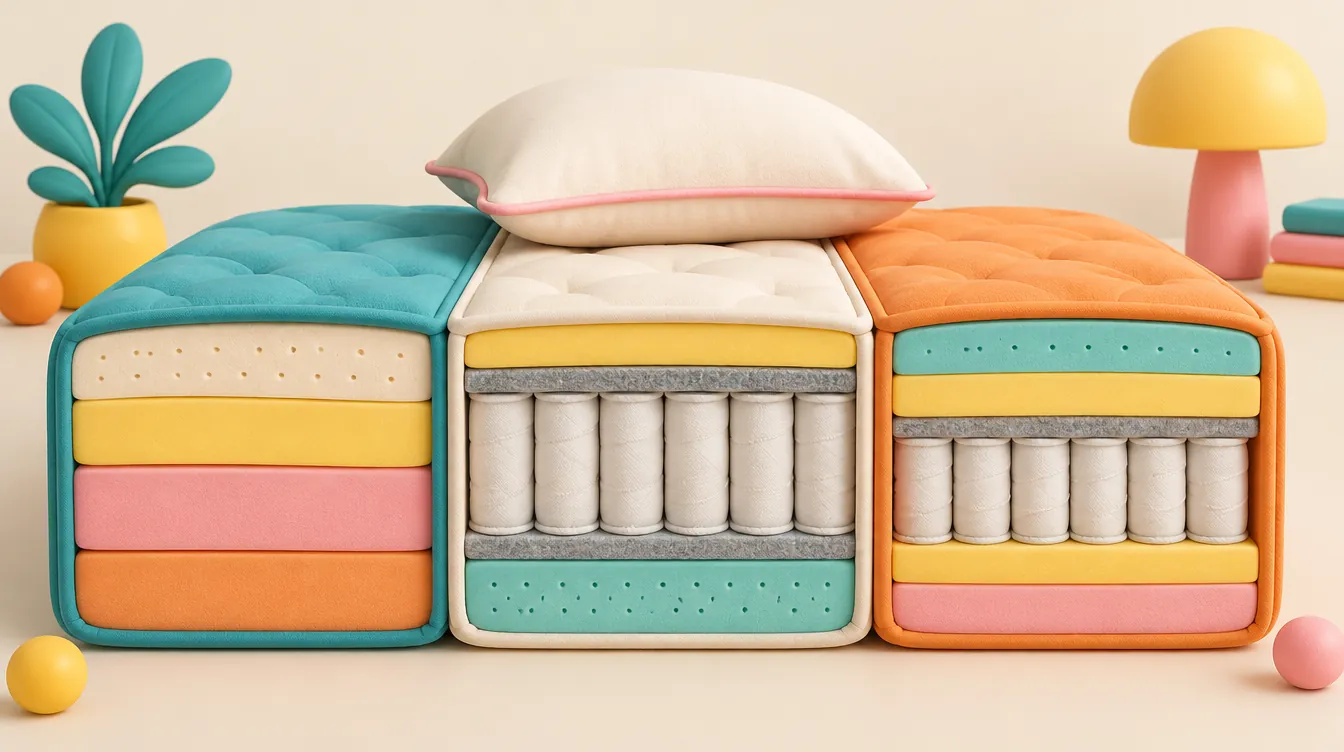
Top Pick (Best Balanced Hybrid): Casper Dream Hybrid (Queen, 12") — Zoned pocketed coils paired with perforated polyfoam deliver easier repositioning, reliable edge stability, and cooler airflow than dense all-foam slabs, backed by a 100-night trial (30-night adjustment period).
Runner-Up (Best All-Foam for Motion Isolation): Nectar Classic 12" Memory Foam (Queen) — Three-layer all-foam construction absorbs partner movement effectively and includes a 365-night home trial, though it sleeps warmer and responds slower than coil-core beds.
Who Should Buy a Hybrid or Innerspring: Hot sleepers, combination sleepers who turn frequently, heavier sleepers needing firmer perimeter support, and anyone who dislikes feeling stuck in slow-rebound foam.
Who Should Buy All-Foam (or Skip a Sale): Side sleepers with sharp shoulder or hip pressure and light sleepers woken by a partner's movements should start with memory foam. Skip any "70% off" sale if the retailer excludes sleep trials, charges high return pickup fees, or inflates the bundle value with accessories you would never purchase separately.
Top Mattress Picks by Construction Type (Queen Size)
| Model & Exact Configuration | Construction & Height | Key Support & Comfort Specs | Best Use Case | Retailer & Price CTA |
|---|---|---|---|---|
Casper Dream Hybrid (Model: 950-000605-004, Queen) |
Hybrid (Foam + Pocketed Coils), 12.0" | Zoned pocketed coil core; Breathe Flex perforated top foam; 100-night trial (30-night minimum) | Hot sleepers & combination sleepers wanting balanced bounce and contour | Check Live Price on Amazon |
Nectar Classic Memory Foam (Model: NECTAR-CL-Q, Queen) |
All-Foam (Memory Foam Core), 12.0" | 3-layer foam stack with gel-infused memory foam; 8" high-density base; 365-night trial | Couples needing maximum motion isolation & side-sleeper pressure relief | Check Live Price on Amazon |
Purple Original Mattress (Model: 10-40-20003, Queen) |
Polymer Grid + Foam Core, 9.25" | 2.0" hyper-elastic GelFlex Grid; dual-layer polyfoam base; 100-night trial | Warm sleepers who want instant response without traditional spring bounce | Best Buy — $1,299 Target Deal (vs. $1,499 MSRP) |
Beautyrest Silver BRS900 (Model: 700810631-1050, Queen) |
Traditional Innerspring, 11.75" | 900-series Pocketed Coil core; thin quilted polyfoam comfort layer; 100-night store trial | Back & stomach sleepers who prefer a classic, buoyant, non-hugging surface | Walmart — $599 Target Deal (vs. $749 MSRP) |
Zinus Green Tea Memory Foam (Model: OLBP-1200-Q, Queen) |
All-Foam (Budget Memory Foam), 12.0" | 3.0" memory foam + 2.0" comfort foam + 7.0" base foam; CertiPUR-US; 100-night retailer return window | Guest rooms & strict entry-level budgets | Check Live Price on Amazon |
Interactive Tool: Mattress Type & True Delivered Deal Calculator
Use this tool to match your sleep profile to the right support core and strip away inflated bundle math before checking out during a mattress sale.
Select your sleep priorities and enter the exact checkout figures (not the crossed-out MSRP) to calculate your recommended construction and true out-of-pocket cost.
Core Construction & Buying Rules: Memory Foam vs. Hybrid vs. Innerspring
A mattress sale can make a well-built bed affordable, or it can make a poor fit look urgent. The practical buying order is fit → construction → trial and return terms → actual delivered price. Choosing the feel before the discount prevents the most expensive mistake in mattress shopping: locking yourself into a bed that causes shoulder pain or traps heat simply because the product page advertised a steep percentage off an inflated list price.
The defining technical distinction between an all-foam mattress and a hybrid is the support core, not whether the top layer contains memory foam. As Sleep Foundation's construction comparison details, all-foam beds rely on high-density polyurethane foam at the base, whereas hybrids pair a pocketed coil support core with substantial comfort layers above it. Meanwhile, Sleep Foundation's mattress shopping guide notes that traditional innerspring mattresses also use steel coil cores, but typically feature thinner, less elaborate comfort systems on top—usually 1 to 2 inches of quilted polyfoam or fiberfill—resulting in a firmer, bouncier, and less contouring surface.
| Construction Type | Typical Feel & Response | Strongest Performance Areas | Primary Trade-Offs to Watch |
|---|---|---|---|
| All-Foam (Including Memory Foam) | Deep contour, slower rebound (2–5 seconds) | Motion isolation, zero spring noise, targeted pressure relief | Heat retention in dense layers, harder repositioning, softer perimeter edges |
| Hybrid (Coils + Comfort Layers) | Balanced cushioning with noticeable lift and bounce | Easier turning, stronger edge support, better internal airflow | Wide quality variance; a 4-inch memory-foam top over coils can still sleep warm |
| Traditional Innerspring | Buoyant, on-top-of-the-bed feel with minimal hug | Immediate response, maximum airflow, lower entry pricing | Higher motion transfer between partners, thinner cushioning at shoulders/hips |
Sleep Position & Body Mechanics
Your primary sleep position dictates how much surface sink your spine can tolerate before alignment suffers:
- Side Sleepers: Shoulder and hip cushioning are non-negotiable. An all-foam mattress or a medium-plush hybrid with at least 3 inches of comfort foam allows the wider parts of your frame to settle in without pinching nerves. A firm, thinly padded innerspring often creates sharp pressure points at the deltoid and greater trochanter. Do not equate "soft" with "unsupportive"—test with your normal pillow and verify that your torso stays level rather than folding toward the center.
- Back Sleepers: You need moderate contour under the lumbar curve paired with a stable core that stops the pelvis from dipping. All-foam, hybrid, and modern pocketed-coil innersprings can all work here; total firmness (typically 5.5 to 7 on a 10-point scale) and transition-layer density matter far more than the category label.
- Stomach Sleepers: Excessive sink around the midsection hyperextends the lower back. Start with a firmer hybrid or traditional innerspring (6.5 to 8 out of 10). If a plush memory-foam bed feels comfortable for five minutes in a showroom but your hips settle noticeably lower than your chest, skip it.
- Combination Sleepers: If you shift positions multiple times a night, slow-rebound memory foam can create a "quicksand" sensation that forces extra effort to turn. A responsive hybrid or polymer-grid mattress with faster recovery makes changing positions effortless.
Heat, Motion Isolation, and Edge Support
Foam conforms closely around your body, which muffles movement from a partner and eliminates coil squeaks. That same close contact reduces convective airflow around your skin, making dense all-foam beds feel warmer. Coils leave open channels inside the mattress core for air to circulate, but the upper 2 to 4 inches determine whether a hybrid actually feels cool. A hybrid topped with thick, non-perforated memory foam will still retain heat, and marketing terms like "cooling gel" printed on a box are not standardized temperature measurements.
If two people share the bed, test motion isolation and edge stability separately. Have one person roll over and exit the bed while the other lies still to judge vibration transfer. Then sit directly on the perimeter and stand up. Pocketed coils reinforced with thicker perimeter wire (often 12- to 13-gauge edge coils) or high-density foam rails help hybrids bridge the gap between quiet motion control and sturdy edges.
Bed-in-a-Box Myths & Spec Traps
"Bed in a box" describes shipping logistics, not internal materials. Both 12-inch all-foam mattresses and 14-inch pocketed-coil hybrids arrive compressed, rolled, and vacuum-sealed in cardboard boxes weighing 75 to 130 pounds. Before ordering, verify three specs: the maximum time the manufacturer allows the bed to stay compressed (typically 30 to 90 days), the required foundation slat spacing (most warranties void if slats are spaced wider than 3 inches apart), and the exact layer diagram. A higher coil count (such as 1,000 micro-coils vs. 800 full-height coils) or a thicker overall profile does not automatically guarantee better durability.
How We Evaluated & Selected These Picks
To separate genuine value from inflated holiday-sale marketing, we evaluated mattresses across four concrete criteria derived from Sleep Foundation testing standards and manufacturer policy disclosures:
- Support Core Integrity & Layer Transparency: We prioritized models that disclose exact profile height (9.25" to 12.0"), coil type (individually wrapped pocketed coils vs. interconnected Bonnell coils), and distinct comfort-layer separation. Any bed hiding behind vague "proprietary foam" descriptions without clear layer breakdowns was excluded.
- Written Sleep Trial & Adjustment Rules: A sleep trial lets you evaluate spinal alignment over weeks, while a warranty only covers manufacturing defects like body impressions exceeding 1.0 to 1.5 inches. We verified official direct trial terms: Casper's trial policy provides a 100-night trial requiring a 30-night adjustment period before returns are arranged; Nectar's trial policy advertises 365 nights; and Purple's mattress listings specify a 100-night trial.
- Channel & Return-Fee Parity: Buying the same mattress through a third-party marketplace, warehouse club, or clearance floor model frequently strips away the manufacturer's home trial or introduces return pickup fees. We flagged channel-specific return windows where applicable.
- True Delivered Price Math: Following our Sale-Price Worksheet standard, we ignored crossed-out list prices and evaluated each model on its net delivered cost—accounting for automatic promos, shipping, required foundations, and treating "free" pillows or sheets as $0 unless you would otherwise buy them at retail.
In-Depth Mattress Reviews
1. Casper Dream Hybrid (12" Queen) — Top Pick for Balanced Support & Airflow
The Casper Dream Hybrid (950-000605-004) is our top overall recommendation for undecided shoppers and couples with mixed sleep positions because it pairs a zoned pocketed-coil core with perforated polyurethane comfort foam. Measuring 12.0 inches tall and weighing roughly 102 pounds in a Queen size, it sits squarely in the sweet spot of medium-firm support (around 6 out of 10) without the sticky, slow-rebound sink of traditional viscoelastic foam.
In practice, the Dream Hybrid's "Breathe Flex" top foam recovers almost immediately when you roll from your side to your back, while the zoned coil layout uses firmer springs under the hips and slightly softer springs under the shoulders. That zoning keeps your spine level without making the mattress feel rigid. Edge support is noticeably stronger than all-foam competitors thanks to a reinforced perimeter around the coil unit, making it comfortable to sit on the edge of the bed when tying shoes.
Honest Flaws & Dealbreakers: At its standard retail positioning, the Casper Dream Hybrid costs noticeably more than budget bed-in-a-box hybrids. Furthermore, Casper's official trial policy requires you to sleep on the mattress for a 30-night break-in period before initiating a return within the 100-night window—and if you buy through a third-party retailer rather than direct, you must follow that specific store's return rules instead.
2. Nectar Classic 12" Memory Foam (Queen) — Runner-Up for Motion Isolation
The Nectar Classic 12" Memory Foam (NECTAR-CL-Q) is the benchmark all-foam option for side sleepers and light sleepers who wake up every time a partner shifts. Its 12.0-inch profile stacks a breathable quilted poly-blend cover over a gel-infused memory foam comfort layer, a responsive transition foam layer, and an 8.0-inch high-density base foam core.
Because there are zero steel springs inside, motion transfer is virtually nonexistent. Side sleepers get deep, even pressure relief across the hips and shoulders, and the bed remains completely silent under movement. Nectar also backs direct purchases with a standout 365-night trial policy, giving buyers a full year across winter and summer bedroom temperatures to decide if the foam feel works long-term.
Honest Flaws & Dealbreakers: Like nearly all 12-inch all-foam mattresses, the Nectar Classic sleeps warmer than coil-core hybrids despite its cooling cover and gel-infused upper layer. Combination sleepers may also find the slower foam rebound slightly tiring when turning over, and sitting directly on the edge causes noticeable compression compared to reinforced hybrids. Always verify that third-party marketplace listings include the full trial rather than a 30-day return limit.
3. Purple Original Mattress (9.25" Queen) — Best for Hot Sleepers Seeking Instant Bounce
The Purple Original Mattress (10-40-20003) takes an entirely different approach to heat and pressure relief by replacing upper memory foam with a 2.0-inch hyper-elastic polymer GelFlex Grid over a dual-layer polyurethane foam base. At 9.25 inches tall, it is thinner than most modern hybrids, yet the open-grid geometry allows air to move freely beneath your body while flexing independently under sharp pressure points like shoulders and hips.
For warm sleepers who hate the trapped feeling of memory foam but still want pressure relief without traditional spring bounce, Purple's grid feels distinctly weightless and responds instantaneously when you change positions. Purple's mattress listings include a 100-night sleep trial when purchased through authorized channels, and the Queen size frequently drops to a $1,299 target deal price (vs. $1,499 MSRP) during major retail promotions at Best Buy and direct.
Honest Flaws & Dealbreakers: The GelFlex Grid has a polarizing, slightly rubbery sensation that you can feel through thin fitted sheets, and the 9.25-inch total profile offers less perimeter edge stiffness than 12-inch pocketed-coil hybrids. Heavier sleepers (over 230 pounds) often find the 2-inch grid bottoms out into the firmer base foam faster than Purple's thicker coil-hybrid models.
4. Beautyrest Silver BRS900 (11.75" Medium Queen) — Best Traditional Innerspring Feel
For back and stomach sleepers who miss the buoyant, "sleep on top of the bed" feel of a classic hotel mattress, the Beautyrest Silver BRS900 (700810631-1050) delivers a true traditional innerspring build at an accessible price—often hitting a $599 target deal price (vs. $749 MSRP) at Walmart. Inside its 11.75-inch profile sits a 900-series Pocketed Coil core topped with thin quilted polyfoam and DualCool fiber layers rather than thick, sinking memory foam.
Because the comfort system is restrained, your body stays supported on the surface, making it effortless to roll over or sit up. Airflow through the tall spring cavity is excellent, and the perimeter holds its shape well when sitting on the side.
Honest Flaws & Dealbreakers: Thin upper quilting means strict side sleepers with narrow shoulders or sensitive hips may find the BRS900 too firm and unyielding. Motion isolation also lags behind all-foam beds, and traditional innersprings shipped flat (not boxed) often carry delivery, setup, or restocking fees depending on the big-box retailer's fulfillment terms.
5. Zinus 12" Green Tea Memory Foam (Queen) — Best Budget All-Foam Under $400
The Zinus 12" Green Tea Memory Foam (OLBP-1200-Q) proves you do not need to spend $1,000 to get a CertiPUR-US certified all-foam mattress for a guest bedroom or short-term apartment. Its 12.0-inch stack uses 3.0 inches of green-tea-infused memory foam, 2.0 inches of comfort foam, and a 7.0-inch high-density base foam core. It contours softly to side sleepers and isolates motion well for its price tier.
Honest Flaws & Dealbreakers: The Zinus relies on standard Amazon or retailer return windows rather than a dedicated 100- to 365-night manufacturer sleep trial with free home pickup. Returning an expanded 12-inch Queen foam mattress that no longer fits in its shipping box can be logistically difficult, and long-term edge sag appears sooner than on denser mid-tier models.
What to Avoid: Fake Discounts, Bundle Math & Trial Traps
Mattress promotions rely heavily on urgency and inflated reference pricing. Before entering your payment details during a holiday sale, watch out for these four common traps:
- Treating Crossed-Out MSRP as Real Savings: Many online brands run perpetual "40% off" or "flash sale" countdowns where the mattress rarely—if ever—sells at its full list price. Always track the actual net checkout price for your exact size and model rather than celebrating a percentage-off banner.
- Counting "Free" Bundles as Cash Back: A sale advertising "$500 in free sleep accessories" (two pillows, a mattress protector, and a sheet set) is only worth $500 if you genuinely needed and planned to buy those exact items at full retail. If you already own pillows you like, assign that bundle a $0 value in your comparison worksheet.
- Ignoring Channel-Specific Trial Exclusions: Never assume a manufacturer's 100-night or 365-night trial applies automatically when you buy the same mattress from a third-party marketplace, a warehouse club, or a clearance outlet. Final-sale floor models, open-box deals, and certain marketplace orders frequently void home trials and manufacturer warranties.
- Overlooking Foundation & Pickup Fees: Some retailers charge $99 to $150 for return pickup or refuse returns if you did not use a compatible solid platform or closely spaced slatted base. Confirm in writing when the trial clock starts (order date vs. delivery date), whether a 30-night break-in period is mandatory, and whether shipping or setup fees are refunded upon return.
Frequently Asked Questions
Is a hybrid mattress always cooler than memory foam?
No. While pocketed coils inside a hybrid create open space for air to circulate, the top comfort layers sit directly beneath your sheets and have the biggest impact on skin temperature. A hybrid topped with 3 to 4 inches of dense, non-perforated memory foam can still trap heat, whereas a breathable cover, open-cell foam, polymer grid, room temperature, and cotton or percale bedding all play major roles.
Does memory foam automatically cause back pain?
No. Back discomfort is driven by poor spinal alignment—usually from a mattress that is either too soft (allowing your hips to sink below your chest) or too firm (creating gaps under your lower back)—rather than the material category itself. Your sleep position, body weight, and total support-layer density determine whether foam or coils keep your spine neutral; consult a clinician for persistent pain.
Do sale mattresses still qualify for a sleep trial?
Often yes, but never assume it at checkout. Manufacturer direct sales during holiday promotions usually preserve the standard 100-night or 365-night trial, though they may require a 30-night adjustment period and exclude final-sale clearance items or free bundle accessories from cash refunds. Purchases made through third-party marketplaces, warehouse clubs, or discount outlets frequently follow the retailer's shorter return window instead.