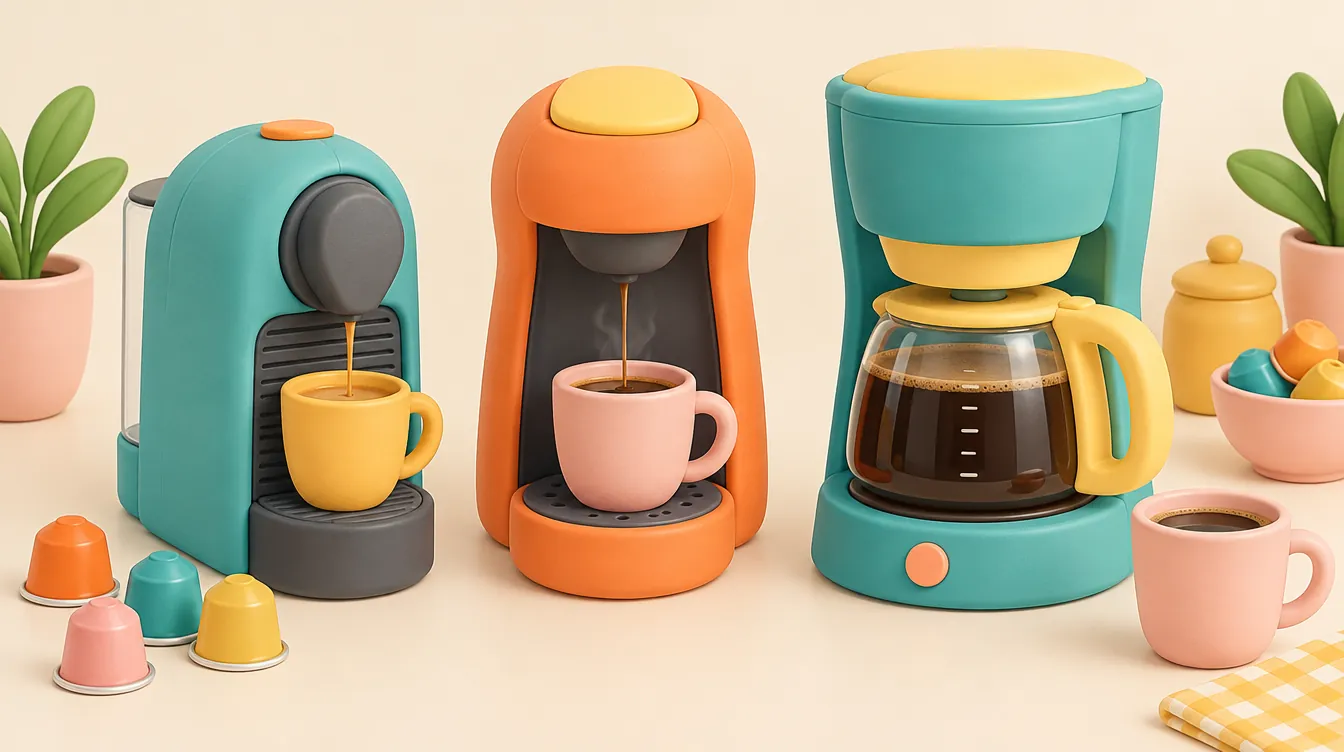
Top Pick (Lowest Total Ownership Cost): Mr. Coffee 12-Cup Programmable Coffee Maker ($19.99 vs. $34.99 MSRP at Target) — Delivers a 60-ounce carafe for shared households and pairs with standard ground coffee at roughly $0.40 per 15-gram serving (~$165 total Year-1 cost).
Runner-Up (Best Single-Mug Convenience): Keurig K-Express ($79.99 direct at Keurig) — Offers 8-, 10-, and 12-ounce brew sizes, a 42-ounce reservoir, and Strong Brew control, keeping Year-1 single-serve costs near $330.70 with store-brand pods.
Best for Capsule Espresso & Crema: De’Longhi Nespresso Vertuo Pop+ ENV92B ($99 vs. $129 MSRP) — Reads capsule barcodes across five drink sizes, though Vertuo refills ($1.40 per 7.77-ounce capsule) push Year-1 costs to ~$610.
Who Should Skip Capsule Deals: Any multi-cup drinker or budget-conscious household that has not priced out a 365-day refill supply. A $19.01 machine discount disappears within weeks when annual capsule spending differs by ~$260.
Top Coffee Maker Deals Compared by Format and Refill Math
| Model & Exact Number | Key Hardware & Capacity Specs | Coffee Format & Serving Control | Best Use Case | Retailer & Price / CTA |
|---|---|---|---|---|
| Mr. Coffee 12-Cup Programmable (Target #A-91863920) | 60-oz glass carafe (twelve 5-oz cups); Brew Later timer; removable filter basket | Ground coffee + paper filters; user controls coffee-to-water ratio | Shared household pots & lowest cost per cup (~$0.40/cup) | Target: $19.99 (MSRP $34.99) |
| Keurig K-Express (Model K25 / K-Express) | 42-oz removable reservoir; compact plastic chassis; Strong Brew button | K-Cup single-serve pods; 8-, 10-, and 12-oz selectable buttons | Solo drinkers wanting quick mugs at separate hours (~$0.69/pod) | Keurig.com: $79.99 Direct |
| De’Longhi Nespresso Vertuo Pop+ (ENV92B) | Optical barcode reader; 5 advertised drink sizes; compact Vertuo housing | Proprietary Vertuo aluminum capsules; capsule barcode dictates size | Espresso-to-coffee capsule drinkers accepting ~$1.40/capsule | De’Longhi: $99.00 (MSRP $129.00) |
| De’Longhi Nespresso Essenza Mini (EN85B) | 19-bar high-pressure pump; 20.3-oz water tank; 25-second thermoblock heat-up | Nespresso Original capsules only (incompatible with Vertuo pods) | Straight espresso & lungo shots with third-party Original pods | Check Live Price on Amazon |
| Ninja 12-Cup Programmable Brewer (CE251) | 60-oz glass carafe; Classic & Rich brew strengths; 24-hour programmable delay | Ground coffee; thermal flavor extraction & mid-brew pause | Drip households wanting stronger extraction & hot-plate control | Check Live Price on Amazon |
Interactive Tool: 1-Year True Coffee Ownership Calculator
Before chasing a percentage-off sticker on a brewer, run your daily routine through this calculator. Enter your machine purchase price, refill format cost, daily cups consumed, and estimated weekly waste to see how hardware savings stack up against 365 days of coffee spending.
Select a preset based on November 6, 2026 observed prices or enter custom numbers for your household.
Core Buying Rules: Why Refill Costs Dictate the Better Deal
Most shoppers compare Nespresso vs Keurig and drip brewers by staring at hardware markdowns on a holiday promo page. That approach gets the math backward. On November 6, 2026, De’Longhi listed the Nespresso Vertuo Pop+ ENV92B at $99 against a $129 MSRP ($30 off), Keurig listed the K-Express at $79.99, and Target listed a Mr. Coffee 12-Cup Programmable drip brewer at $19.99 against a $34.99 MSRP ($15 off). Looking purely at hardware, only $19.01 separates the Vertuo Pop+ from the K-Express, and $79.01 separates the Vertuo Pop+ from the Mr. Coffee.
Once you factor in 365 days of coffee, those machine discounts become rounding errors. Using retail refill prices verified on November 6, 2026, a single daily serving over one year produces drastically different totals:
| Coffee Example | Retail Pack Price (Nov. 6, 2026) | Assumed Serving Size | Cost per Serving | 365-Day Coffee Cost | Year-1 Total (w/ Machine) |
|---|---|---|---|---|---|
| Nespresso Melozio Vertuo (Target #A-89938060) | $56.00 for 40 capsules | 1 capsule (7.77 fl oz) | $1.40 | $511.00 | ~$610.00 |
| Good & Gather House Blend Pods (Target #A-78617242) | $10.99 for 16 pods | 1 pod (8-oz setting) | ~$0.69 | $250.71 | $330.70 |
| Good & Gather House Blend Grounds (Target #A-78630655) | $8.99 for 12 oz (340g) | 15g grounds (budget baseline) | ~$0.40 | ~$145.00 | ~$165.00 |
Notice the spread: switching between the Melozio Vertuo capsule and the store-brand K-Cup pod saves roughly $260.29 per year for a one-cup-a-day drinker—more than 13 times the $19.01 upfront difference between the Vertuo Pop+ and the K-Express. If a two-person household brews two drinks each per day (four servings total), annual refill spending climbs to $2,044 for Vertuo capsules versus $1,002.84 for store-brand pods or ~$580 for drip grounds. At that consumption rate, the machine hardware represents less than 5% of Year-1 ownership costs on either capsule platform.
Compatibility rules also lock buyers into specific refill ecosystems the moment a brewer is unboxed. Nespresso splits its hardware into two mechanically incompatible lines: Vertuo machines (such as the ENV92B) use centrifugal spinning and optical barcode reading on dome-shaped capsules, while Original machines (such as the Essenza Mini EN85B) pierce smaller flat-bottomed capsules under 19 bars of pressure. Melozio Vertuo capsules explicitly will not fit or brew in a Nespresso Original machine, and vice versa. Keurig K-Express machines accept standard K-Cup pods and reusable universal filters, whereas drip brewers take loose grounds in any grind size matched to a flat-bottom or cone paper filter.
Finally, understand serving terminology before buying for capacity. Drip manufacturers define one "cup" as 5 fluid ounces, meaning a 12-cup Mr. Coffee carafe holds 60 fluid ounces total—enough for five 12-ounce travel mugs, not twelve. Similarly, the Keurig K-Express advertises a 42-ounce water reservoir, which simply reduces how often you walk to the sink rather than increasing individual brew strength.
How We Evaluated and Calculated True Ownership Costs
To compare these three brewing formats fairly without relying on manufacturer savings claims, we established strict cost, spec, and ergonomic baselines:
- Cost-Per-Consumed-Cup Modeling: Rather than treating every brewed ounce as drunk, our ownership framework measures coffee cost per consumed cup across a 365-day baseline. A 12-ounce bag of ground coffee equals roughly 340 grams; using a 15-gram illustrative dose yields roughly 22 to 23 single mugs (~$0.40 per cup at $8.99). However, if a solo drinker brews a half-carafe and pours three cups down the drain every week, that waste inflates real ingredient costs and narrows drip’s advantage over single-serve pods.
- Excluded Variable Costs: Our 365-day comparison tables isolate coffee and hardware cash outlays. Sales tax, paper filters ($0.02–$0.04 per drip batch), descaling solutions, milk, electricity, shipping fees, and leftover partial packages carried into Year 2 are excluded so readers see clean apples-to-apples ingredient pricing.
- Reservoir-to-Serving Ratio & Clearance: We evaluated reservoir volume (42 oz on the K-Express vs. 60 oz carafe on the Mr. Coffee), height clearance needed to lift top lids or remove brew baskets under standard 18-inch kitchen upper cabinets, and whether a machine controls strength via electronics (Keurig Strong Brew, Nespresso barcode RPMs) or manual dosing (drip grounds).
- Bundle & Subscription Audits: Holiday listings frequently mask true unit prices behind "starter kits" or multi-month Auto-Delivery contracts. Any machine offer tied to mandatory recurring pod shipments, cancellation penalties, or inflated retail valuations on included milk frothers was flagged separately from standalone cash prices.
In-Depth Coffee Maker Reviews
1. Mr. Coffee 12-Cup Programmable Coffee Maker (Target #A-91863920) — Best Overall Value for Households
At $19.99 against a $34.99 MSRP at Target, the Mr. Coffee 12-Cup Programmable brewer is the undisputed budget anchor in this comparison. Constructed primarily from lightweight matte black plastic with a 60-ounce borosilicate-style glass carafe and a nonstick warming plate, it strips away specialty screens and pressurized pumps in favor of a simple drip showerhead and a standard removable brew basket. The footprint stays compact enough for apartment counters, though you must reserve vertical clearance above the hinged lid to pour water and load paper basket filters cleanly.
Where the Mr. Coffee wins is routine flexibility and recurring cost control. Because it accepts any brand of ground coffee—from $8.99 12-ounce supermarket bags to bulk warehouse tins or local whole-bean roasts—your refill budget is never dictated by a proprietary pod patent. The front control panel includes a Brew Later 24-hour programmable timer, allowing households to stage grounds and water at night for a 6:30 a.m. pot, alongside a Grab-a-Cup auto-pause feature that stops basket flow for roughly 30 seconds if you pull the carafe mid-cycle.
Honest Flaws & Dealbreakers: Five-ounce cup markings on the carafe confuse buyers who expect twelve full mugs, and the hot plate will bake scorched flavors into leftover coffee if left on past 45 minutes. For a solo drinker consuming one 8-ounce mug daily, measuring grounds, rinsing the filter basket, and discarding stale leftovers makes a 60-ounce drip machine unnecessarily tedious compared to single-serve pods.
2. Keurig K-Express Single-Serve Coffee Maker — Best for Single-Mug Convenience
Priced at $79.99 directly on Keurig.com, the K-Express targets solo drinkers and multi-schedule households who want hot coffee in under two minutes without leftover carafe waste. Built with an injection-molded plastic housing and a 42-ounce removable side water reservoir, it measures under 5.5 inches wide, letting it slip beside toaster ovens or inside narrow dorm spaces. A removable drip tray accommodates tall travel mugs up to roughly 7 inches when removed, eliminating angled-pour spills.
On the control side, the K-Express gives you three push-button brew volumes—8, 10, and 12 ounces—plus a dedicated Strong Brew button that slows water pulse speed to extract darker flavor from the same K-Cup pod. In day-to-day use, sticking to the 8-ounce setting is critical for cup quality; for instance, Target’s Good & Gather House Blend pods ($10.99 for 16 pods, or ~$0.69 each) explicitly recommend the 8-ounce brew size. Selecting the 12-ounce button on a standard 10-to-12-gram pod stretches the same coffee grounds across 50% more water, trading body for volume.
Honest Flaws & Dealbreakers: Unlike the Nespresso Vertuo Pop+, the K-Express relies on a low-pressure hot water needle rather than a high-RPM centrifuge or 19-bar pump, meaning it cannot produce true espresso shots or dense crema. Furthermore, Keurig’s direct storefront frequently pairs discounted machine pricing with Auto-Delivery subscription commitments; skipping the fine print can lock you into minimum box quotas and early cancellation fees that erase the hardware markdown.
3. De’Longhi Nespresso Vertuo Pop+ (ENV92B) — Best for Espresso and Capsule Variety
Listed at $99 against a $129 MSRP by De’Longhi in Liquorice Black, the Vertuo Pop+ ENV92B is the entry ramp into Nespresso’s modern capsule ecosystem. Visually cleaner and shorter than legacy VertuoPlus models, it features a plastic body, a side-mounted removable water tank, and a spring-loaded top brew head that locks into place with a side lever. Inside the head sits an optical laser that reads the printed barcode on the rim of each aluminum Vertuo capsule, automatically adjusting water volume, temperature, infusion pause, and spin speed (up to several thousand RPM) across five advertised drink styles ranging from 1.35-ounce single espresso to 7.77-ounce mug-sized coffee.
That barcode automation produces thick, aerated foam crema across the top of every cup—an unmistakable mouthfeel upgrade over standard K-Cups if you enjoy café-style Americanos or iced espresso over milk. Because Nespresso manages extraction parameters per capsule, beginners do not need to dial in grind size, tamping pressure, or shot timing.
Honest Flaws & Dealbreakers: Refill math is steep and completely closed. At $56 for a 40-count pack of Melozio Vertuo capsules at Target ($1.40 per cup), one daily 7.77-ounce coffee costs $511 per year—more than double store-brand K-Cups and roughly 3.5 times supermarket drip grounds. Because Nespresso’s Vertuo barcode patent remains tightly protected, you will not find $0.45 off-brand Vertuo pods lining grocery shelves. Also note that the Pop+’s shorter chassis leaves tight vertical clearance under the spout for tall insulated tumblers, and its spent-capsule bin holds only about 5 to 8 pods before needing emptying.
4. De’Longhi Nespresso Essenza Mini (EN85B) — Best Compact Original-Line Espresso Maker
If you strictly want true high-pressure espresso shots rather than 8-ounce morning mugs, the De’Longhi Nespresso Essenza Mini (EN85B)—available via Check Live Price on Amazon—solves the Vertuo ecosystem’s biggest price trap. Weighing barely 5 pounds with a 3.3-inch-wide footprint and a 20.3-ounce removable reservoir, it uses a 19-bar high-pressure pump and a 25-second fast thermoblock heater to pull 1.35-ounce Espresso and 3.7-ounce Lungo shots through traditional piercing extraction.
The decisive financial advantage of the Essenza Mini over the Vertuo Pop+ lies in patent expiration: Nespresso Original capsules are widely manufactured by third-party roasters including Lavazza, Peet’s, Illy, and supermarket house brands. While official Nespresso Vertuo capsules hover around $1.25 to $1.40+, third-party Original capsules routinely retail between $0.45 and $0.75 per shot, slashing annual espresso costs by nearly half without sacrificing real crema.
Honest Flaws & Dealbreakers: The Essenza Mini cannot brew a standard 8- to 12-ounce American drip mug in a single capsule; you must pull double shots over hot water to build a large cup. Its 20.3-ounce tank and 6-capsule catch tray require frequent refilling and emptying, and Original capsules are completely incompatible with Vertuo machines.
5. Ninja 12-Cup Programmable Coffee Brewer (CE251) — Best Upgraded Drip Brewer
For households that want drip economics without the thin extraction common to $20 entry-level pots, the Ninja 12-Cup Programmable Brewer (CE251)—available via Check Live Price on Amazon—upgrades every touchpoint of the Mr. Coffee formula. It pairs a 60-ounce glass carafe and a 60-ounce removable water reservoir (a welcome improvement over pouring pitchers into a fixed rear tank) with a dedicated Classic and Rich brew-strength selector, small-batch 1-to-4-cup calibration, and an adjustable warming plate timer.
Using Ninja’s thermal flavor extraction heating element, the CE251 keeps water closer to optimal extraction temperatures (~195°F–205°F) throughout the cycle rather than sputtering lukewarm water at the start and end of the pot. Because it still uses standard paper cone filters and bagged ground coffee, your ingredient cost remains pinned near ~$0.40 per 15-gram cup.
Honest Flaws & Dealbreakers: At roughly 14.5 inches tall with a deeper counter footprint, the CE251 crowds low-hanging kitchen cabinets more than the $19.99 Mr. Coffee. If your household only drinks one cup every morning, its higher upfront price takes longer to justify than a basic brewer unless you regularly utilize the small-batch setting.
What to Avoid: Discount Traps and Compatibility Mistakes
Holiday coffee sales are crowded with bundle quirks and misleading price framing. Avoid these four expensive traps before entering payment details:
- Ignoring Dollar-Off vs. Ownership Cost: A $30 discount on the Vertuo Pop+ ($99 vs. $129) looks twice as generous on a banner ad as a $15 discount on the Mr. Coffee ($19.99 vs. $34.99). However, percentage and dollar markdowns measure retail margin, not household value. Verify your annual coffee bill first, and browse our Target store deal guide and Cyber Monday shopping checklist to separate genuine hardware drops from seasonal noise.
- Buying Wrong-System Nespresso Capsules: Retailers often stack Original and Vertuo sleeves on the same endcap display. Dome-shaped Vertuo capsules (such as Melozio) will not fit inside an Original-line machine, and cylindrical Original pods will fail inside a Vertuo Pop+. Always match the exact system word printed on the capsule box to your machine’s model name.
- Falling for Auto-Delivery Starter Kits: Keurig’s website pairs select brewer discounts with multi-box Auto-Delivery subscriptions. Read the checkout terms carefully: these offers explicitly carry minimum pod purchase quotas and cancellation fees if you terminate deliveries early. Unless you already buy that exact capsule volume every month, pay the standalone cash price instead.
- Overvaluing Unwanted Bundle Extras: Machine-plus-frother combos and 30-count variety samplers look tempting when retailers quote inflated "if purchased separately" values. If you drink black coffee or dislike flavored caramel and hazelnut pods, a discounted bundle with a frother or flavored sampler costs more in real cash than buying a standalone brewer plus one pack of coffee you actually enjoy.
Frequently Asked Questions
Is Nespresso cheaper than Keurig?
No, Nespresso is typically more expensive than Keurig in the Vertuo-vs-K-Cup comparison, though exact totals depend on your capsule selection and daily volume. Based on November 6, 2026 Target pricing, a 40-count pack of Nespresso Melozio Vertuo capsules costs $56 ($1.40 per capsule, or $511 annually at one cup per day), compared to $10.99 for 16 Good & Gather House Blend pods (~$0.69 per pod, or $250.71 annually). Even though only $19.01 separated the $99 Vertuo Pop+ and the $79.99 Keurig K-Express hardware, the ~$260 annual refill gap quickly dwarfs any upfront machine discount.
Is drip coffee always the cheapest option?
Drip coffee carries the lowest ingredient cost per brewed serving in standard retail comparisons—roughly $0.40 per 15-gram dose using an $8.99, 12-ounce bag of ground coffee (~$145 per year at one cup daily)—but habits determine real savings. Our baseline figure excludes paper filters, descaling supplies, and wasted coffee poured down the sink. If a solo drinker regularly brews half a 60-ounce pot and discards leftover cups, or buys $22 specialty whole beans instead of $9 supermarket grounds, single-serve pods can end up costing about the same per cup actually consumed.
Can I use any Nespresso capsule in any machine?
No, Nespresso capsules are strictly locked to two mutually incompatible brewing platforms: Vertuo and Original. For example, Melozio Vertuo capsules designed for barcode-reading machines like the De’Longhi Vertuo Pop+ ENV92B cannot physically fit or brew inside Original-line machines like the Essenza Mini, and Original capsules will not work in Vertuo brewers. Always confirm the exact system name printed on both the brewer box and the capsule carton before purchasing gift bundles or bulk holiday assortments.