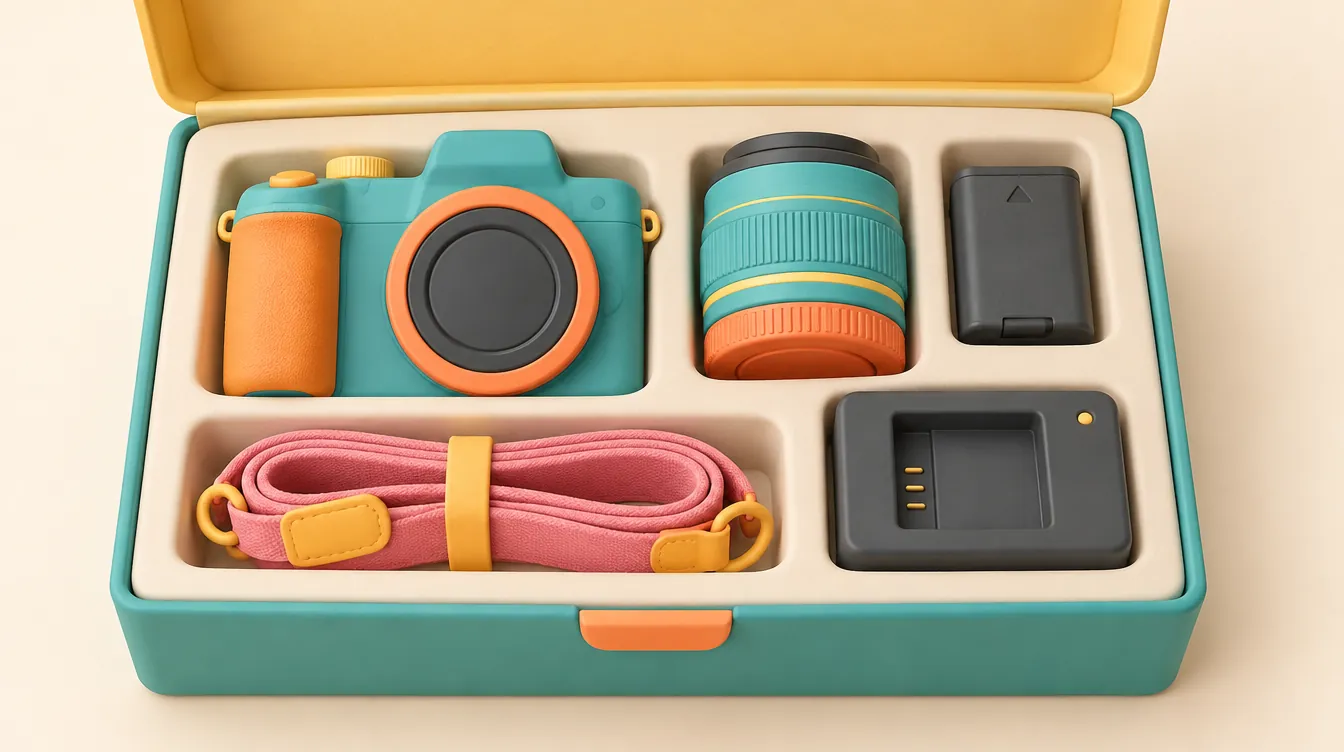
Quick Verdict: Camera Kit Contents & Best Bundles
Top Pick — Canon EOS R50 (RF-S 18-45mm f/4.5-6.3 IS STM Kit, Model 5811C012): The most approachable hybrid camera kit for everyday stills and 4K/30p video, pairing fast Dual Pixel CMOS AF II with an included LC-E17 wall charger. Just budget $20–$35 extra for a UHS-I V30 SD card and USB-C cable, which Canon explicitly omits from the factory box.
Runner-Up — Nikon Z fc (NIKKOR Z DX 16-50mm f/3.5-6.3 VR Kit, Model 1672): Delivers magnesium-alloy construction, dedicated exposure dials, a wider 24mm-equivalent kit lens, and an included MH-32 wall charger—though legacy F-mount lens users must factor in an FTZ II adapter and verify feature compatibility.
Who Should Buy a Factory Kit: First-time mirrorless buyers, parents, travelers, and desk-video creators who want a warranty-backed body, matched kit zoom, and factory battery at a lower combined price than buying the body and lens separately.
Who Should Skip It: Buyers lured by 20-piece third-party accessory bundles filled with no-name 0.43x lens attachments and slow Class 10 SD cards, or photographers expecting a memory card, HDMI cable, and second battery inside a standard manufacturer box.
Buying a camera labeled as a "kit" or "bundle" frequently creates a costly surprise on unboxing day: most manufacturer camera kits do not contain everything required to take and transfer your first photograph. A factory single-lens kit typically supplies the camera body, one zoom lens, one battery, a strap, and a charging method—while intentionally omitting memory cards, data cables, spare power, and lens adapters. Meanwhile, third-party retailer bundles pad their item counts with generic filters, duplicate nylon pouches, and slow storage cards to make a standard kit appear discounted. Comparing total out-of-the-box readiness rather than raw accessory count is the only reliable way to evaluate what a camera kit is actually worth.
Top Camera Kits Compared: Exact Contents & Missing Essentials
| Camera Kit (Exact Model) | Sensor & Card Slot | Included Lens & Weight | Power & Missing Box Items | Best Use Case | Retailer & Price |
|---|---|---|---|---|---|
Canon EOS R50 Kit (5811C012) |
24.2MP APS-C; 1x SD (UHS-I) | RF-S 18-45mm f/4.5-6.3 IS STM; 505g combined | LP-E17 + LC-E17 wall charger; no SD card, USB-C, or HDMI cable | Everyday family photos & 4K/30p hybrid shooting | Best Buy — $699.99 deal vs. $799.99 MSRP |
Nikon Z fc Kit (1672 / VOA090K001) |
20.9MP APS-C; 1x SD (UHS-I) | NIKKOR Z DX 16-50mm f/3.5-6.3 VR; 580g combined | EN-EL25 + MH-32 wall charger; no SD card, USB, or HDMI cable | Tactile stills shooting & wider indoor framing | B&H Photo — $996.95 deal vs. $1,099.95 MSRP |
Sony ZV-E10 Kit (ILCZV-E10L/B) |
24.2MP APS-C; 1x SD (UHS-I) | E PZ 16-50mm f/3.5-5.6 OSS; 459g combined | NP-FW50 + USB-C cable & AC adapter; no external charger or SD card | Desk vlogging, streaming & lightweight video | Check Live Price on Amazon |
Canon EOS R10 Kit (5331C012) |
24.2MP APS-C; 1x SD (UHS-II) | RF-S 18-45mm f/4.5-6.3 IS STM; 559g combined | LP-E17 + LC-E17 wall charger; no SD card, USB-C, or HDMI cable | Fast-action bursts (15 fps) & 4K/60p video | Target — $979.99 deal vs. $1,099.99 MSRP |
Sony Alpha a6400 Kit (ILCE-6400L/B) |
24.2MP APS-C; 1x SD (UHS-I) | E PZ 16-50mm f/3.5-5.6 OSS; 519g combined | NP-FW50 + Micro-USB cable & AC adapter; no external charger or SD card | Weather-sealed travel & outdoor photography | Walmart — $848.00 deal vs. $999.99 MSRP |
Interactive Tool: Camera Kit Readiness & True-Cost Calculator
Before comparing two camera listings at different prices, calculate the real cost of making each kit shoot-ready. Select a factory kit preset (or enter a custom bundle price), choose your primary shooting plan, and toggle any accessories omitted from the seller's box-contents list.
Camera Kit True-Cost & Compatibility Calculator
Select a factory kit to pre-load its known box omissions, then add your missing essentials.
Check Items Missing From Your Listing (Add to Budget):
Core Box Contents, Compatibility & Buying Rules
Camera manufacturers treat the phrase "lens kit" strictly: it means the standard camera body box plus one or two specific lenses, not a complete starter studio. According to Canon's official EOS R50 User Guide, the standard factory package includes only the camera body, Battery Pack LP-E17, Battery Charger LC-E17, Strap EM-200DB, shoe cover, and body cap—explicitly excluding a memory card, USB interface cable, and HDMI cable. Canon further instructs lens-kit buyers to manually verify that their expected lens or lenses are present inside the box upon delivery.
That omission list catches thousands of new photographers off guard. Without a Secure Digital (SD) memory card, a new mirrorless camera cannot save photos or record 4K video out of the box; most modern bodies disable the shutter entirely by default or display a "No Card" lock when empty. Likewise, without a USB-C data cable or an SD card reader, you cannot offload RAW images to a laptop, and without a Type-D micro-HDMI cable, you cannot connect the camera to an external monitor or capture card.
Before comparing prices across retailers like Best Buy, Amazon, B&H, Target, or Walmart, build a four-line contents audit for every listing:
- Camera body exact SKU and condition: Confirm the exact model code (for example,
5811C012for Canon's single-lens EOS R50 kit versus5811C022for the two-lens kit) and verify the listing is factory-new US stock rather than "open-box," "refurbished," or an international gray-market import lacking regional warranty coverage. - Full lens designation and mount: Never settle for vague descriptions such as "standard zoom lens." Record the exact focal length, maximum aperture range, and stabilization tag (e.g.,
RF-S 18-45mm f/4.5-6.3 IS STMorNIKKOR Z DX 16-50mm f/3.5-6.3 VR) to ensure it fits your body natively without requiring an adapter. - Memory card presence and speed rating: Check whether a card is actually included or merely shown in lifestyle photos beside the camera. Confirm both capacity (64GB–128GB minimum for 4K video) and sustained write speed class (
U3/V30minimum). - Battery and charging architecture: Check whether the box includes a standalone wall charger (such as Canon's LC-E17 or Nikon's MH-32) or relies solely on in-body USB charging (such as Sony's ZV-E10 and a6400). In-body USB charging ties up the entire camera whenever a battery needs power, forcing heavy shooters to spend $45–$60 on an external cradle later.
Lens compatibility demands the same line-by-line scrutiny if you already own older camera equipment. A shared brand name on the lens cap does not guarantee plug-and-play operation on a new mirrorless body. As Nikon's official Z fc Reference Manual documents, using older F-mount NIKKOR lenses on the Z fc requires purchasing Nikon's Mount Adapter FTZ (or FTZ II), and certain lens generations lose features or face autofocus restrictions through the adapter. Screw-drive AF and AF-D lenses without built-in focus motors, for instance, drop to manual focus only on FTZ adapters. If your buying plan hinges on older glass, price the OEM adapter ($249.95 for Nikon FTZ II; $129.99 for Canon EF-EOS R) into your comparison before choosing a body-only SKU over a matched kit lens.
How We Audited Kit Completeness & Hardware Thresholds
To separate genuinely shoot-ready kits from misleading packages, we audited manufacturer box-contents documentation, official user manuals, CIPA battery ratings, card-slot bus speeds, and optical focal equivalents across current APS-C mirrorless starter kits. We eliminated kits with discontinued sensor generations lacking reliable eye-detection autofocus, bodies restricted to slow 720p/1080p-only video pipelines, and listings whose bundled accessories fall below modern recording standards.
Storage Speed & Recording Thresholds
Every kit camera recommended here records 4K UHD video at roughly 100 Mbps to 120 Mbps (12.5 MB/s to 15 MB/s) and fires RAW bursts between 11 and 15 frames per second. Older Class 10 or UHS-I U1 cards guarantee only 10 MB/s sustained write speeds, causing 4K video recordings to abort abruptly after 10–20 seconds and locking photo buffers during burst sequences. Our baseline threshold for any kit is a UHS-I U3 / V30 SDXC card (30 MB/s minimum sustained write, typically $18–$25 for 128GB). For cameras equipped with a UHS-II bus like the Canon EOS R10, stepping up to a UHS-II V60 card ($50–$65 for 128GB) unlocks rapid buffer clearing during sustained 15 fps RAW bursts.
Power & Ergonomic Baselines
Small APS-C mirrorless batteries—Canon's LP-E17 (1,040 mAh), Nikon's EN-EL25 (1,120 mAh), and Sony's NP-FW50 (1,020 mAh)—rate between 230 and 440 shots per charge under CIPA standardized testing. In real-world 4K video or continuous autofocus shooting, a single cell lasts roughly 50 to 85 minutes. Kits that include a dedicated wall charger earn higher usability marks because you can charge a spare battery in your bag while shooting with the primary cell.
The Three-Subject Planning Rule
Before paying for any bundle, write down the three specific subjects you plan to photograph or film during your first month. Family gatherings and indoor dinners favor a wider 16mm kit zoom (24mm full-frame equivalent) and reliable eye autofocus; distant wildlife or field sports require extending beyond 50mm with a 50–250mm or 55–210mm telephoto second lens; and desk videos or live streams prioritize a side-flipping vari-angle LCD, 3.5mm microphone input, and clean USB-C UVC webcam output.
In-Depth Reviews of the Top 5 Camera Kits
1. Canon EOS R50 with RF-S 18-45mm f/4.5-6.3 IS STM Kit (5811C012) — Top Pick
The Canon EOS R50 single-lens kit is the strongest overall entry point for buyers transitioning from a smartphone to interchangeable-lens photography and 4K video. Inside the compact 116.3 x 85.5 x 68.8 mm polycarbonate chassis sits a 24.2MP APS-C CMOS sensor paired with Canon's DIGIC X processor and Dual Pixel CMOS AF II—the same subject-tracking architecture found in Canon's higher-tier EOS R7 and R10. People, animal, and vehicle detection lock onto moving eyes across nearly 100% of the frame without requiring complex menu diving.
Canon ships the 5811C012 kit with the collapsible RF-S 18-45mm f/4.5-6.3 IS STM lens (29–72mm full-frame equivalent), which weighs just 130 grams and adds optical image stabilization rated up to 4 stops (up to 6.5 stops when paired with bodies featuring IBIS, though the R50 lacks in-body stabilization). Combined with the 375-gram body (battery and card weight included), the entire camera-and-lens kit weighs barely half a kilogram and slips easily into a small crossbody bag. Importantly, Canon includes the external LC-E17 wall charger alongside the LP-E17 battery, giving you off-camera charging from day one.
Honest Flaws & Box Omissions: Following Canon's official package documentation, the box contains zero storage media and zero data/video cables; you must add a V30 SD card before taking your first frame. The single SD slot sits inside the battery compartment and supports only UHS-I speeds, capping continuous RAW burst depth. At 29mm equivalent, the 18-45mm lens is also noticeably tighter indoors than Nikon's or Sony's 16-50mm (24mm equivalent) kit zooms, and its narrow f/6.3 maximum aperture at 45mm forces high ISO levels in dim living rooms. Finally, the EOS R50 uses Canon's newer multi-function hot shoe without traditional center-pin contacts on older models unless you buy the AD-E1 adapter for legacy flashes.
2. Nikon Z fc with NIKKOR Z DX 16-50mm f/3.5-6.3 VR Kit (1672) — Runner-Up
If build materials and tactile manual controls matter as much to you as image quality, the Nikon Z fc kit stands apart from every plastic entry-level camera in its price bracket. Inspired by Nikon's classic FM2 film SLR, the Z fc wraps magnesium-alloy top, bottom, and front plates around a 20.9MP APS-C CMOS sensor and EXPEED 6 processor. Dedicated machined aluminum dials govern shutter speed, ISO, and exposure compensation directly on the top plate, paired with a small monochrome top-deck aperture readout and a fully articulating 3.0-inch vari-angle touchscreen.
Nikon pairs the body (445g with battery and card; 134.5 x 93.5 x 43.5 mm) with the silver-finished NIKKOR Z DX 16-50mm f/3.5-6.3 VR lens (135g). Starting at 16mm (24mm full-frame equivalent) gives this lens a clear framing advantage over Canon's 18-45mm for tight indoor rooms, architecture, and arm's-length vlogging, while built-in Vibration Reduction (VR) steadies handheld stills up to 4.5 stops. Nikon supplies an EN-EL25 battery and MH-32 wall charger in the kit, and also supports USB-C power delivery for charging on the go.
Honest Flaws & Compatibility Caveats: Like Canon, Nikon ships no SD card and no HDMI cable in the standard kit box. Ergonomically, the retro flat front plate offers no deep right-hand grip, making the camera front-heavy if you later mount larger telephoto glass without adding an aftermarket grip extension. Its EXPEED 6 autofocus tracks eyes reliably in good light, though it trails Canon's Dual Pixel II and Sony's Real-time Tracking on erratic fast-moving subjects. And per Nikon's Z fc manual, adapting existing F-mount DSLR lenses requires the optional FTZ/FTZ II adapter ($249.95) and sacrifices autofocus on older screw-drive AF/AF-D lenses.
3. Sony Alpha ZV-E10 with E PZ 16-50mm f/3.5-5.6 OSS Kit (ILCZV-E10L/B) — Best for Video & Streaming
Built specifically for creators shooting desk tutorials, interviews, and travel clips, the Sony ZV-E10 trims weight to 343 grams (body with battery and card; 115.2 x 64.2 x 44.8 mm) while retaining a 24.2MP Exmor APS-C sensor and Sony's expansive E-mount lens ecosystem. Unlike pure photography bodies, the ZV-E10 box includes a snap-on furry windscreen for its three-capsule directional top microphone alongside both a 3.5mm microphone input and a 3.5mm headphone monitoring jack. Its USB-C port supports UVC/UAC plug-and-play streaming directly into a computer for crisp 1080p/720p video calls without an external HDMI capture dongle.
The bundled E PZ 16-50mm f/3.5-5.6 OSS lens (116g) is a power-zoom pancake optic that retracts nearly flat when powered off and offers a 24–75mm full-frame equivalent range with Optical SteadyShot stabilization. Sony also includes a dedicated "Product Showcase" button that shifts focus instantly from a presenter's face to an object held toward the lens, plus a single-press Background Defocus toggle.
Honest Flaws & Box Omissions: Sony omits a standalone wall charger from the ZV-E10 box, supplying only an AC adapter and USB-A to USB-C cable for in-camera charging of the NP-FW50 battery; if you buy a spare battery, you cannot charge both simultaneously without buying an external charger separately. The ZV-E10 also omits an electronic viewfinder (EVF) entirely, making outdoor composition in harsh noon sunlight frustrating on the rear LCD. In video mode, 4K/30p applies a 1.23x sensor crop (sticking to 4K/24p avoids the crop), and rapid handheld panning triggers noticeable rolling-shutter skew.
4. Canon EOS R10 with RF-S 18-45mm f/4.5-6.3 IS STM Kit (5331C012) — Best for Action & Fast Bursts
Stepping up from the EOS R50 to the Canon EOS R10 kit trades a slightly larger footprint (429g with battery and card; 122.5 x 87.8 x 83.4 mm) for serious mechanical controls and burst throughput. Where the R50 offers a single rear dial and lacks an AF joystick, the R10 adds dual command dials, a dedicated eight-way AF multi-controller joystick, an M-Fn customizable button, and a sculpted deep handgrip that balances comfortably with heavier telephoto lenses.
Under the hood, the R10 upgrades the single SD slot to a UHS-II bus, allowing its 15 fps mechanical shutter (and 23 fps electronic shutter) to clear RAW bursts far faster when paired with a V60 or V90 card. Video shooters also gain 4K/60p recording (with a 1.56x crop) alongside uncropped 6K-oversampled 4K/30p. The box contents mirror the R50: you receive the body, RF-S 18-45mm f/4.5-6.3 IS STM lens, LP-E17 battery, LC-E17 wall charger, and strap.
Honest Flaws & Box Omissions: Canon still omits the SD card, USB-C cable, and micro-HDMI cable from the R10 kit, and because the camera benefits heavily from UHS-II storage, budgeting for a proper V60 SD card adds $50–$65 rather than $22. Despite its enthusiast controls, the R10 uses the same relatively small 1,040 mAh LP-E17 battery as the R50 (rated at 350–430 shots CIPA), lacks weather sealing, and omits in-body image stabilization.
5. Sony Alpha a6400 with E PZ 16-50mm f/3.5-5.6 OSS Kit (ILCE-6400L/B) — Best Weather-Sealed Value
Although the Sony a6400 debuted earlier than its rivals, its magnesium-alloy dust- and moisture-resistant body (403g with battery and card; 120.0 x 66.9 x 59.7 mm) remains a durability standout under $900. Photographers shooting in dusty parks, light mist, or bright outdoor stadiums get a sharp 2.36-million-dot OLED electronic viewfinder and Sony's sticky 425-point phase-detection Real-time Tracking autofocus, paired with the compact E PZ 16-50mm f/3.5-5.6 OSS kit zoom. Unlike older Sony models capped at 29 minutes of video, the a6400 records uncropped 4K/24p (and 1.23x-cropped 4K/30p) continuously until battery or storage runs out.
Honest Flaws & Box Omissions: The a6400 reveals its age at the I/O ports: it charges in-body via an outdated Micro-USB port rather than USB-C, and includes no external wall charger or SD card in the box. Its 180-degree upward-tilting rear screen also physically collides with any microphone mounted in the top hot shoe if you try to film yourself, forcing vloggers to buy a side-relocating cold-shoe bracket.
What to Avoid: Bloated Accessory Bundles, Spec Traps & Gray-Market Kits
Online marketplaces routinely list factory kits alongside inflated "24-Piece Mega Creator Bundles" priced $30 to $80 higher than the base kit. Resist treating accessory count as dollar value. Unpacking those third-party kits almost always reveals low-margin filler items with near-zero real-world utility:
- Screw-on 0.43x wide-angle and 2.2x telephoto converters: These generic front-thread glass attachments degrade corner sharpness, introduce severe purple chromatic aberration, and often cause vignetting on 16mm and 18mm kit lenses.
- Three-piece UV/CPL/FLD filter packs and tulip lens hoods: Cheap uncoated glass filters create ghosting and flare against streetlamps or sunlight, while generic screw-on hoods frequently block wide-angle corners or won't reverse-mount for storage.
- Sub-spec SD cards: Many multi-piece bundles toss in an unbranded or Class 10 / U1 32GB or 64GB SD card that chokes 4K video bitrates and forces you to buy a V30 card separately anyway.
- Flimsy 50-inch aluminum tripods and duplicate pouches: Lightweight sub-$15 tripods wobble in mild wind and use plastic leg locks that snap under mirrorless camera loads. Always ask for exact brand and model numbers on any retailer-added tripod, card, or spare battery; if a seller cannot name them, assign those extras $0 value when comparing prices.
Watch out for two additional pitfalls before clicking buy. First, verify lens-inclusion wording on discount listings: some third-party sellers show product thumbnails with a lens attached on a "Body Only" SKU, shipping an empty front cap with no lens inside. Second, avoid "International Model" or "Import Version" kits priced $100 below authorized US retailers like Best Buy, B&H, Target, or official Amazon storefronts. Manufacturers routinely deny warranty repairs on gray-market serial numbers outside their designated region, and those boxes may contain non-US wall plugs or limited menu languages.
Frequently Asked Questions
Does a camera lens kit always include a memory card and cables? No. Official manufacturer lens kits almost never include a memory card, and several major brands exclude data and video cables as well. Canon's EOS R50 manual explicitly states that the standard package excludes a memory card, USB interface cable, and HDMI cable while advising lens-kit buyers to check that their lenses are included. A retailer may add a memory card to a custom bundle, so verify the card's exact presence, capacity, and V30/UHS-II speed class in the written "In the Box" section before ordering.
Can I use lenses from my older DSLR on a new mirrorless camera kit? Often yes, but only with a compatible brand mount adapter and potential feature limitations. Nikon's Z fc manual explains that older F-mount NIKKOR lenses attach via the Mount Adapter FTZ or FTZ II, while warning that certain functions may be restricted or unavailable depending on the specific lens generation (for example, losing autofocus on screw-drive AF/AF-D lenses without internal focus motors). Always check the camera maker's official adapter compatibility chart and include the adapter's price ($130–$250) in your total budget before choosing a body-only offer.
Is a retailer camera bundle with 15+ accessories automatically better value than a factory kit? No. Bloated retailer bundles typically pad their item counts with generic lens attachments, uncoated UV filters, microfiber cloths, card wallets, and slow U1/Class 10 SD cards that you would never purchase individually. Instead of counting total pieces, price the exact factory kit alongside separately chosen essentials you actually need—such as a named UHS-I V30 or UHS-II V60 SDXC card ($22–$58) and a genuine spare OEM battery ($50–$65)—and compare the true shoot-ready totals side by side.