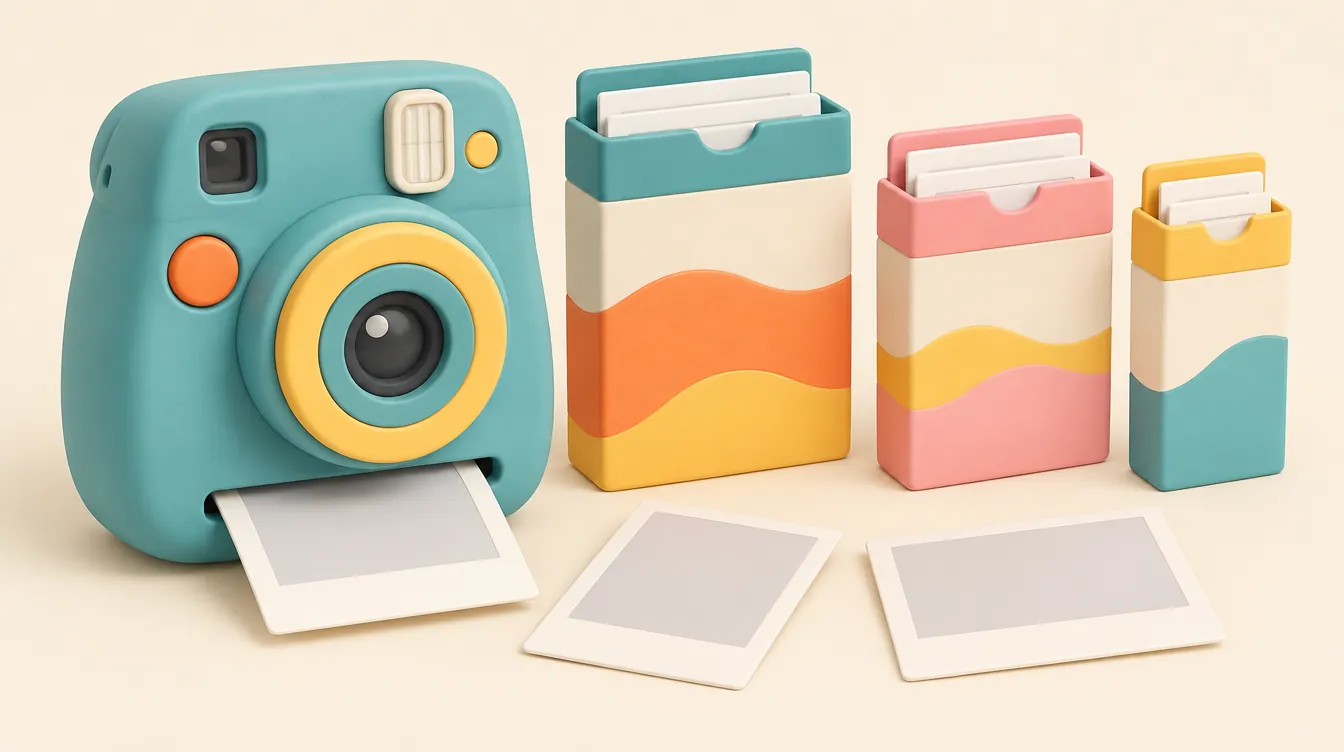
No—you cannot load Instax SQUARE or Instax WIDE film into an Instax mini camera, nor can you swap any of the three formats between mismatched hardware. Fujifilm engineers Instax mini, SQUARE, and WIDE as physically distinct, non-interchangeable cartridge systems with different chassis widths, ejection roller spans, and optical focal paths. Matching the exact film family printed on the cartridge box to the exact camera or smartphone printer model is mandatory before you buy refills or camera bundles.
Top Pick (Best Mini Camera): Fujifilm Instax Mini 12 — Uses Instax mini film (86 × 54 mm print; 62 × 46 mm image area). Simple twist-lens operation, automatic exposure, and parallax-corrected close-up framing make it the most reliable entry point, though film is sold separately.
Runner-Up (Best Larger-Format Camera): Fujifilm Instax SQUARE SQ1 — Uses Instax SQUARE film (86 × 72 mm print; 62 × 62 mm image area). Delivers 34.8% more image surface area than mini film in a balanced 1:1 ratio without the bulk of WIDE bodies.
Who Should Buy It: Gift buyers, event hosts, and casual shooters who want predictable instant prints and low cost-per-shot refills—provided they verify the film format and total exposure count before checking out.
Who Should Skip It: Anyone expecting a single film pack to fit multiple Instax camera sizes, or shoppers lured by accessory-heavy bundles that include stickers and plastic frames instead of actual film exposures.
Instax Camera, Printer & Film Comparison Table
| Product & Exact Model | Supported Film Format | Key Hardware & Film Specs | Best Use Case | Retailer & Price |
|---|---|---|---|---|
Fujifilm Instax Mini 12 (INSTAX MINI 12) |
Instax mini (86 × 54 mm; 62 × 46 mm image) | 104 × 66.6 × 122 mm; 306 g; 2× AA batteries; 0.3–0.5 m close-up mode | Everyday snapshots & lowest per-shot film cost | Check Live Price on Amazon |
Fujifilm Instax SQUARE SQ1 (INSTAX SQUARE SQ1) |
Instax SQUARE (86 × 72 mm; 62 × 62 mm image) | 130.7 × 118.6 × 57.5 mm; 390 g; 2× CR2 lithium batteries; auto exposure | Balanced 1:1 portraits & travel framing | Target: $109.99 (MSRP $119.95) |
Fujifilm Instax WIDE 300 (INSTAX WIDE 300) |
Instax WIDE (86 × 108 mm; 62 × 99 mm image) | 167.8 × 94.7 × 120.9 mm; 612 g; 4× AA batteries; 95 mm f/14 lens | Group photos, weddings & landscape prints | B&H Photo: $119.00 (MSRP $129.95) |
Fujifilm Instax Mini Link 2 (INSTAX MINI LINK 2) |
Instax mini (86 × 54 mm; 62 × 46 mm image) | 91.9 × 36.4 × 124.8 mm; 210 g; rechargeable Li-ion (~100 prints/charge); Bluetooth 4.2 | Editing & printing phone photos on demand | Best Buy: $89.99 (MSRP $99.95) |
Fujifilm Instax Mini Twin Pack (16437396 / 20 Exposures) |
Instax mini only (ISO 800 color film) | 2 × 10-shot cartridges (20 total exposures); 86 × 54 mm white border | High-value baseline refill for all mini hardware | Check Live Price on Amazon |
Interactive Instax Compatibility & Cost-Per-Shot Calculator
Instax Format Matcher & Bundle Value Calculator
Select your exact camera or printer to confirm the required film cartridge, then audit any refill or bundle price by cost per exposure.
Core Instax Film Compatibility Rules
Fujifilm’s official compatibility guide divides every instant camera and smartphone printer in its lineup into three mutually exclusive film families: mini, SQUARE, and WIDE. Each family uses a rigid plastic cartridge housing an ISO 800 light-sensitive emulsion, a chemical developer pod, and a spring-loaded pressure plate engineered to match a specific camera chamber and motor-driven roller width. Because the cartridge dimensions and focal plane distances are fixed in hardware, there is no adapter, firmware update, or shooting mode that allows an Instax mini camera to accept SQUARE or WIDE film.
Every Instax film sheet measures exactly 86 mm along one axis, while the second axis scales dramatically across the three formats:
- Instax mini: 86 × 54 mm overall sheet size, yielding a 62 × 46 mm image area (2,852 mm²).
- Instax SQUARE: 86 × 72 mm overall sheet size, yielding a 62 × 62 mm image area (3,844 mm²—34.8% larger than mini).
- Instax WIDE: 86 × 108 mm overall sheet size, yielding a 62 × 99 mm image area (6,138 mm²—more than double mini’s image surface).
Before adding film to your cart, read the full model name stamped on the front or bottom of the camera or printer and cross-reference it against the manufacturer’s specification sheet. For example, Fujifilm’s specification page for the Instax mini 12 explicitly names Instax mini film and notes that film is sold separately—meaning the box contains the camera, wrist strap, and batteries, but zero exposures unless a retailer explicitly bundles film.
Do not rely on product lifestyle photography when shopping online. Retailers frequently display an Instax camera surrounded by sample prints or bundle mixed film packs in the same search result. Always verify the exact word mini, SQUARE, or WIDE on the film packaging itself. Decorative borders—such as Macaron, Rainbow, Mermaid Tail, Contact Sheet, or Monochrome frames—are purely cosmetic variations within a single format. Buying a decorative SQUARE pack will not make it fit a mini camera, just as a decorative mini border does not alter the 86 × 54 mm sheet size.
How We Evaluated Hardware, Film Formats & Bundle Math
To separate genuine value from misleading bundle listings, we audited Fujifilm’s current hardware specifications across all three film families alongside real-world retail packaging conventions. Our evaluation focused on four measurable criteria:
- Mechanical & Optical Format Lock: We verified cartridge compatibility directly against Fujifilm’s official product matrix. Any camera or smartphone printer—such as the Mini Link 2 or SQUARE Link—must pair exclusively with its designated cartridge family. If a household owns both a mini camera and a mini printer, they can share the same 10-shot cartridges; if one person owns a mini 12 and another owns an Instax WIDE 300, film supplies cannot be shared.
- Cost Per Confirmed Exposure: Instead of judging a deal by the number of items in a bundle photo, we divide the final checkout price of the film (or the incremental cost of a camera bundle over the bare camera MSRP) by the total confirmed exposure count. Using a simple baseline calculation, 20 exposures priced at $16.00 equal $0.80 per shot. That $0.80/shot benchmark makes it immediately obvious when a $22 decorative 10-pack ($2.20/shot) or an accessory-stuffed bundle is charging a steep premium.
- Power & Portability Trade-Offs: Larger formats require wider bodies and higher battery draw to push wider developer pods through steel rollers. We weighed chassis dimensions, gram weight, and battery chemistry (AA alkaline vs. CR2 lithium vs. internal Li-ion) to identify which models travel easily and which belong at stationary events.
- Included-Film Transparency: When comparing Target offers or seasonal promotions, we flagged whether the SKU includes usable film cartridges in the box or requires a separate refill purchase before the recipient can take a single photo.
In-Depth Reviews: Best Instax Cameras, Printers & Film Packs
1. Fujifilm Instax Mini 12 (Best Overall Mini Camera)
The Fujifilm Instax Mini 12 is the cleanest, most dependable entry point into the Instax mini ecosystem. Measuring 104 × 66.6 × 122 mm and weighing 306 g without batteries, its rounded, matte-textured polycarbonate shell is slightly more compact and grippy than the older Mini 11. Fujifilm replaced the Mini 11’s pull-out lens barrel with a rotary twist-ring around the 60 mm f/12.7 lens: twist once to power on, twist a second time to engage Close-Up Mode for subjects between 0.3 m and 0.5 m.
That Close-Up Mode fixes the biggest frustration of older mini cameras—off-center framing. The Mini 12 incorporates automatic parallax correction that physically shifts the viewfinder framing target when you twist into close-up range, keeping faces centered on the 62 × 46 mm image area. Automatic exposure controls both shutter speed (1/2 to 1/250 sec) and flash output, preventing blown-out skin tones indoors. It runs on 2× AA alkaline batteries rated for roughly 10 film packs (100 shots).
Flaws & Dealbreakers: Film is not included in the standard retail box, so you must budget separately for Instax mini cartridges. You also cannot disable the automatic flash, which limits stealthy shooting in museums or dark venues, and there is no tripod mount or self-timer.
2. Fujifilm Instax SQUARE SQ1 (Best Larger-Format Camera)
If the 86 × 54 mm mini print feels too cramped for two-person portraits, the Fujifilm Instax SQUARE SQ1 steps up to 86 × 72 mm film with a 62 × 62 mm square image area. That extra 16 mm of image width adds 34.8% more visual real estate while preserving a classic 1:1 aspect ratio that looks natural in wall grids and photo albums without rotating the camera between portrait and landscape orientation.
Physically, the SQ1 measures 130.7 × 118.6 × 57.5 mm and weighs 390 g. Its squared-off, textured grip feels substantially more secure in adult hands than the bulbous Mini 12, and its twist-ring 65.75 mm f/12.6 lens offers the same straightforward On and Selfie (0.3–0.5 m) detents. Exposure is fully automated, handling bright outdoor patios and dim living rooms reliably.
Flaws & Dealbreakers: Unlike the Mini 12 and WIDE 300, the SQ1 runs on 2× CR2 lithium batteries rather than common AA cells. CR2 batteries cost more and are harder to find at corner drugstores if your camera dies mid-trip. Instax SQUARE film also carries a higher baseline cost per shot than mini film, and the SQ1 drops creative double-exposure modes found on the discontinued SQ6.
3. Fujifilm Instax WIDE 300 (Best Camera for Groups & Events)
For wedding guestbooks, family reunions, and wide landscapes where mini prints turn faces into tiny dots, the Fujifilm Instax WIDE 300 delivers Fujifilm’s largest instant print: 86 × 108 mm sheets with a 62 × 99 mm image area. That horizontal frame provides more than double the image area of Instax mini film, giving group shots genuine detail.
Because the film cartridge itself is over 110 mm wide, the WIDE 300 is a hefty camera at 167.8 × 94.7 × 120.9 mm and 612 g (excluding its 4× AA batteries). It uses a motorized 95 mm f/14 lens with two manual focus zones (0.9–3 m and 3 m to infinity) plus a clip-on close-up adapter for 40 cm shots. Unlike the fully automatic Mini 12 and SQ1, the WIDE 300 includes an LCD screen on the back, a tripod socket, and a lighten/darken exposure compensation button (±2/3 EV) that rescues backlit outdoor scenes.
Flaws & Dealbreakers: The WIDE 300 is bulky enough to require a dedicated neck strap or large tote bag, and its power switch is prone to accidentally bumping on inside an unpacked backpack. Note that Fujifilm’s newer WIDE 400 drops the manual lighten/darken control in favor of a self-timer, so event shooters who want manual exposure tweaks should seek out the WIDE 300 while stock remains.
4. Fujifilm Instax Mini Link 2 (Best Smartphone Printer for Shared Mini Film)
If you already own an Instax mini camera—or hate wasting expensive ISO 800 shots on blurry, blinked-out captures—the Fujifilm Instax Mini Link 2 prints directly from iOS and Android phones onto standard Instax mini cartridges. Measuring 91.9 × 36.4 × 124.8 mm and weighing 210 g, it slips into a jacket pocket and connects over Bluetooth 4.2.
Its internal rechargeable lithium-ion battery prints roughly 100 sheets per charge and prints each 86 × 54 mm sheet at 318 dpi in about 15 seconds (followed by the standard 90-second chemical development). Because the Mini Link 2 uses the exact same Instax mini cartridges as the Mini 12, Mini 40, and Mini Evo, a household can buy bulk mini twin packs and split them seamlessly between an analog camera and a phone printer.
Flaws & Dealbreakers: Printed smartphone photos have slightly lower dynamic range and softer contrast than dedicated dye-sublimation printers like the Canon Selphy, and the Mini Link 2 charges via an older Micro-USB port rather than USB-C (if USB-C is a priority, step up to the newer Mini Link 3).
5. Fujifilm Instax Mini Twin Pack (16437396 — 20 Exposures)
When stocking up on refills, the plain white-border Fujifilm Instax Mini Twin Pack (2 cartridges × 10 exposures = 20 total exposures) is the gold-standard benchmark. Every sheet uses ISO 800 daylight-balanced film (5500K) that develops in roughly 90 seconds at room temperature (5°C–40°C operating range). Buying plain twin packs—or bulk 60-exposure value boxes—consistently yields the lowest cost per shot, allowing you to save specialty borders for holidays or party favors without overpaying for everyday snapshots.
What to Avoid: Accessory Traps & Compatibility Pitfalls
Even experienced shoppers get tripped up by three recurring retail traps when buying Instax gear:
- Accessory-Bloated "Mega Bundles": Third-party marketplace sellers routinely pair a bare Instax Mini 12 with a faux-leather case, 60 paper stickers, plastic desk frames, colored lens filters, and a mini photo album—while including only 10 or 20 exposures of actual film. Always strip out the perceived value of trinkets and divide the bundle’s extra cost by the confirmed exposure count. If you are paying $40 over the bare camera’s street price for 20 sheets of film and plastic clips, you are paying $2.00 per shot. Buy the camera and a standalone multi-pack of film separately instead.
- Confusing "Twin Pack" With Specific Quantities: Never assume a listing titled "Twin Pack" or "Value Bundle" contains a fixed number of sheets without reading the exact exposure count in the specifications. Verify whether a listing sells 20 exposures (two 10-shot cartridges), 40 exposures, or 60 exposures—and confirm every cartridge inside a multi-pack matches your camera’s format.
- Decorative Border Upcharges & Expired Stock: Specialty borders (such as metallic, black, or patterned frames) frequently cost 25% to 60% more per exposure than plain white-border film. Compare equivalent plain-border prices before treating a "20% off" sticker on decorative film as a genuine bargain. Finally, check the expiration date stamped on the foil-wrapped carton if buying discounted clearance stock; instant film chemicals dry out and shift toward magenta or washed-out green tones past expiration or after prolonged storage in hot warehouses. Add both your exact film format and target exposure count to your shopping checklist before seasonal sales begin.
Frequently Asked Questions
Can I load SQUARE film into a mini 12 to make larger pictures?
No. Fujifilm specifies Instax mini film exclusively for the Instax mini 12, and its official compatibility guide assigns Instax SQUARE film to separate SQUARE-series cameras and printers. The SQUARE cartridge is 18 mm wider than a mini cartridge and physically cannot fit inside the mini 12’s film door or roller assembly. If larger prints are your priority, you must buy a SQUARE or WIDE camera.
Can a camera and a smartphone printer use the same film?
Yes, provided both devices specify the exact same Instax film format. For example, an Instax mini 12 camera and an Instax Mini Link 2 smartphone printer both use 86 × 54 mm Instax mini cartridges, so you can share bulk mini film packs between them. However, an Instax mini camera cannot share cartridges with an Instax SQUARE Link or Instax Link WIDE printer.
Does a “twin pack” tell me how many photos I can take?
Not reliably on its own—you should always read the stated total exposure count on both the product listing and the outer box rather than guessing from the bundle name. Standard Instax cartridges hold 10 exposures each, so a genuine Fujifilm twin pack typically equals 20 exposures, but third-party sellers sometimes combine multipacks of varying sizes or formats. Record the exact exposure total before dividing the price to compare value.