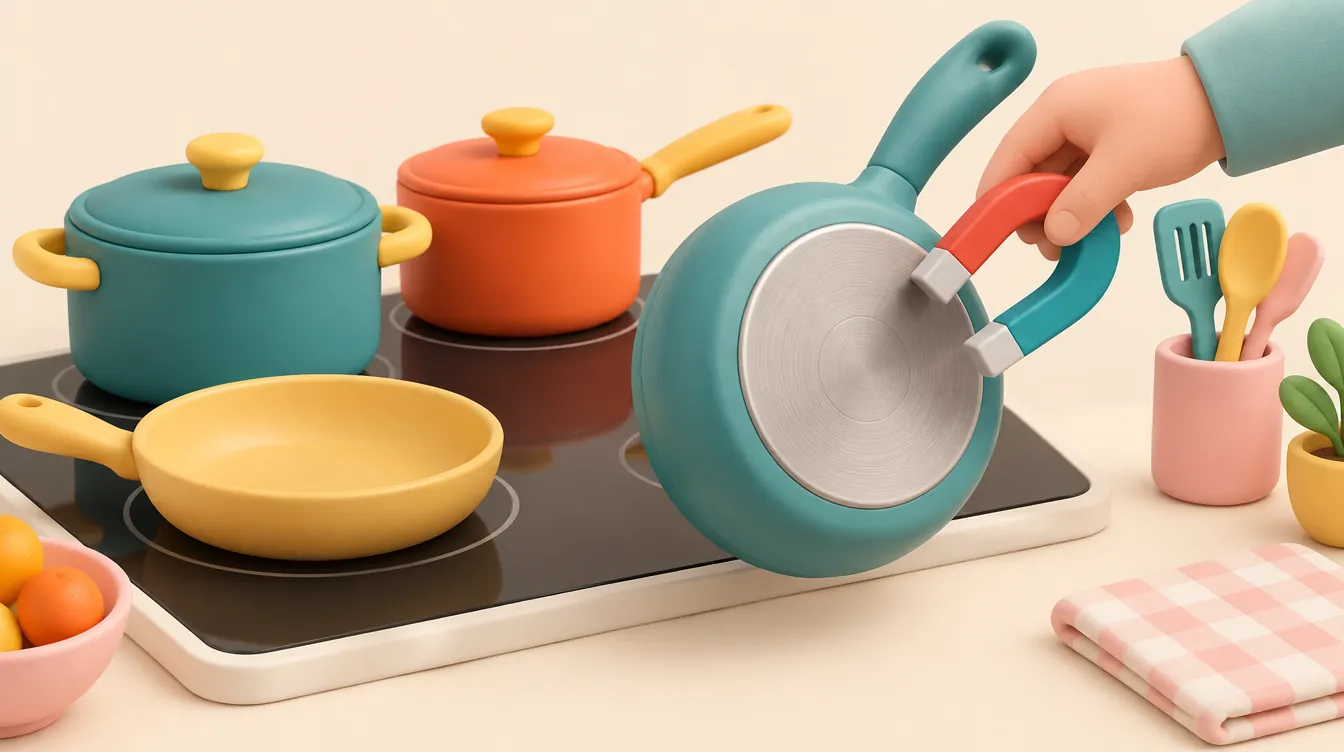
Quick Verdict: Induction Cookware Compatibility & Top Replacements
Before replacing your entire kitchen, test your current pans with a refrigerator magnet and a ruler. [GE Appliances](https://products.geappliances.com/appliance/gea-support-search-content?contentId=16895) confirms that a pan needs a magnetic, flat base that meets your cooktop manual's minimum zone diameter—not just an "induction-ready" rim diameter. When you do need to fill gaps, stick to full-clad or heavy cast iron vessels with wide, flat contact surfaces.
- Top Pick (Single Skillet): All-Clad D3 Stainless Steel 10-Inch Fry Pan (Model 4110) — Full edge-to-edge 430 magnetic stainless steel exterior with a generous 7.5-inch flat cooking base and zero coil-sensing dropouts.
- Runner-Up (Best Value): Tramontina Tri-Ply Clad 12-Inch Fry Pan (Model 80116/007DS) — Delivers 90% of All-Clad's thermal stability and a wide 9.25-inch magnetic contact footprint for under $55.
- Who Should Buy New Pans: Homeowners whose existing cookware fails the bottom magnet hold test, features warped bases exceeding 1 mm of bow, or uses undersized impact-bonded discs smaller than the cooktop's minimum burner ring.
- Who Should Skip Full Sets: Anyone who already owns a flat-bottomed cast iron skillet, enameled Dutch oven, or tri-ply stockpot that passes the magnet and base-diameter check—replace only the missing daily drivers.
Top Induction-Compatible Cookware Replacements at a Glance
| Model & Exact Number | Base Construction | Flat Magnetic Base | Weight | Best Use Case | Retailer & Price CTA |
|---|---|---|---|---|---|
All-Clad D3 10" Fry Pan (4110) |
Tri-ply 18/10 + Al core + 430 SS | 7.5 in. | 2.6 lbs | Daily sautéing & pan sauces | Check Live Price on Amazon |
Tramontina Tri-Ply 12" Fry Pan (80116/007DS) |
Tri-ply 18/10 + Al core + 18/0 SS | 9.25 in. | 3.1 lbs | Large-batch searing on 8"–11" zones | Walmart — $49.97 (MSRP $69.95) |
Lodge 10.25" Cast Iron Skillet (L8SK3) |
Solid ferromagnetic grey iron | 8.0 in. | 5.35 lbs | High-heat searing & oven transfers | Check Live Price on Amazon |
Made In 3-Qt Stainless Clad Saucier (SC-3QT) |
5-ply clad w/ 430 SS exterior | 5.75 in. | 3.5 lbs | Reductions & whisking on 6" zones | Check Live Price on Amazon |
Cuisinart MultiClad Pro 12-Piece Set (MCP-12N) |
Tri-ply 18/10 + Al core + 430 SS | 5.25"–8.5" | 24.5 lbs (set) | Full kitchen induction conversion | Best Buy — $269.99 (MSRP $299.95) |
Interactive Tool: Induction Pan & Zone Compatibility Checker
Use this calculator to verify whether an existing pan in your cabinet—or a pan you are considering buying—will trigger the electromagnetic coils on your specific induction cooktop without error codes or uneven heating.
Induction Cookware Base & Zone Compatibility Checker
Measure the flat magnetic area on the bottom of your pan (not the top rim) and check your cooktop manual's minimum/maximum zone size.
Core Compatibility Rules: Inspect the Base Instead of Relying on the Label
Switching to an induction range or cooktop does not automatically require throwing out your entire cookware cabinet. Induction elements generate a high-frequency oscillating magnetic field through copper coils beneath the ceramic glass; that field induces electrical eddy currents directly inside a ferromagnetic pan bottom, turning the vessel itself into the heat source. Because there is no radiant heating element, cookware compatibility depends entirely on metallurgy, base geometry, and physical dimensions.
Start by testing the pans you use at least twice a week. Record their brand, model names, flat base measurements, and whether a standard refrigerator magnet holds firmly underneath. GE Appliances specifically recommends checking whether a magnet sticks and holds to the cookware's bottom before assuming a pan will work. If the magnet slides off or barely clings, the pan lacks sufficient ferritic iron or 400-series stainless steel to couple efficiently with the induction coil.
A common mistake is measuring the top rim of a skillet and assuming it matches the heating surface. GE's size guidance warns that you must measure the flat magnetic area on the bottom, which is frequently 1.5 to 3 inches smaller than the advertised pan diameter. For example, a 10-inch flared skillet often has only a 7-inch flat bottom, and an impact-bonded pan might have an even smaller 6-inch magnetic disc inset inside a 7-inch aluminum base. Compare that flat magnetic measurement directly against your intended cooking zone rather than using the lid diameter.
| Check | What to Record | Why It Changes Your Purchase |
|---|---|---|
| Magnetic base | Magnet holds firmly underneath | Confirms the basic ferromagnetic induction requirement |
| Base size | Flat magnetic diameter (inches) | Allows exact comparison with the cooktop's minimum zone size |
| Base shape | Flat contact surface (< 0.5 mm bow) | Prevents air-gap power loss and high-pitched coil buzzing |
| Appliance model | Manual's minimum/maximum pan sizes | Avoids assuming every 6", 8", or 11" zone shares the same threshold |
GE directs owners to consult their specific appliance manual for minimum pan sizes, because induction zones do not behave identically across brands or even across burners on the same cooktop. A typical 6-inch simmer element may require a minimum 4.5-inch magnetic base, while an 11-inch 3,700-watt bridge or power-boil zone often refuses to activate unless it detects at least a 6.5- to 7-inch magnetic footprint.
Do not judge a pan by a broad material label. Check stainless steel pans individually: 18/8 and 18/10 austenitic stainless steel (304-grade) is non-magnetic, meaning older single-ply or aluminum-clad stainless pots without a 430-grade (18/0) ferritic exterior layer will fail the magnet test. Conversely, do not automatically reject cookware advertised as having an "aluminum core." Multi-ply clad pans—such as 3-ply and 5-ply stainless steel—sandwich an aluminum core between an 18/10 cooking surface and a magnetic 430 stainless exterior, giving you rapid heat distribution alongside full induction compatibility.
Bring your inventory list and measurements to your Home Depot appliance comparison or showroom visit. Price replacement cookware only after identifying which daily-use vessels fail the magnet, flatness, or zone-size checks.
How We Evaluated & Selected Replacement Cookware
When your existing skillet or saucepan fails the magnet or base-diameter check, replacing it piece by piece saves money and cabinet space compared to buying a bloated 14-piece set. To identify the best replacement cookware for induction cooktops, we screened candidates against four strict hardware thresholds:
- Full Ferromagnetic Coupling: We excluded pans using thin, perforated magnetic induction plates stamped onto bare aluminum bottoms. While perforated discs technically trigger induction coils, they heat unevenly and create hot spots along the holes. Every stainless pick below uses a solid, edge-to-edge 430 or 18/0 ferritic stainless steel exterior layer (or solid grey cast iron) for uniform eddy-current generation.
- Flatness Tolerance Under 0.5 mm: Induction coils lose efficiency rapidly as the air gap between the glass and pan widens. Warped pans also rock on smooth ceramic glass and amplify 20–50 kHz coil vibration into audible buzzing. We prioritized heavy-gauge 2.6 mm to 3.0 mm clad bodies and rigid cast iron that resist thermal warping on 3,000W+ Boost settings.
- Generous Flat Magnetic Footprint: We measured the actual flat contact diameter on the bottom of each pan—not the flared rim—to ensure compatibility with standard 6-inch, 8-inch, and 10- to 11-inch induction zones.
- Honest Vessel-to-Price Value: Following our shopping checklist methodology, we counted actual cooking vessels separately from lids and utensils when evaluating sets, ensuring you never overpay for filler pieces.
In-Depth Individual Product Reviews
1. All-Clad D3 Stainless Steel 10-Inch Fry Pan (Model 4110) — Top Pick
If your primary 10-inch skillet fails the magnet test, the All-Clad D3 10-Inch Fry Pan (4110) is the most reliable one-for-one replacement on the market. Constructed in Canonsburg, Pennsylvania, the D3 uses a bonded 3-ply architecture: an 18/10 stainless steel cooking interior, a thick 1.7 mm pure aluminum core for lateral heat conductivity, and an exterior layer of 430 ferritic stainless steel. Because the 430 stainless wraps all the way up the flared sidewalls, the pan couples cleanly with induction coils without any of the edge-drop-off or buzzing common to disc-bottomed cookware.
In physical measurements, the 4110 measures 10.25 inches across the flared rim and provides a 7.5-inch flat magnetic base. That 7.5-inch footprint hits the sweet spot for almost every residential induction cooktop: it easily clears the 5.5- to 6.5-inch minimum threshold of medium 8-inch zones while maintaining enough contact area to run efficiently on 10-inch elements. Weighing 2.6 pounds without a lid, it has enough thermal mass to hold sear temperatures when cold steak hits the surface, yet remains light enough for one-handed sautéing.
The honest dealbreaker for some cooks is All-Clad's signature cupped stainless steel handle. Its deep U-shaped groove locks your thumb in place during wrist-flicks, which prevents twisting, but the sharp edges can dig into your palm if you lift a full pan bare-handed. Additionally, the flared rim is not rolled for drip-free pouring, so transferring thin pan sauces requires a deliberate tilt. Even with those ergonomic quirks, its warp resistance and lifetime warranty make it the benchmark 10-inch induction skillet.
2. Tramontina Tri-Ply Clad 12-Inch Fry Pan (Model 80116/007DS) — Runner-Up (Best Value)
For households running large 10- or 11-inch induction zones—or anyone who needs a family-sized skillet without spending over $120—the Tramontina Tri-Ply Clad 12-Inch Fry Pan (80116/007DS) delivers exceptional performance at roughly $49.97 (compared to its $69.95 MSRP) at Walmart. Like the All-Clad D3, Tramontina's Brazil-made clad line bonds an 18/10 stainless interior and an aluminum core to a magnetic 18/0 (430-grade) stainless steel exterior.
The standout specification here is the 9.25-inch flat magnetic base. Many 12-inch skillets taper aggressively down to an 8-inch bottom, leaving wasted glass around the perimeter of an 11-inch induction coil. Tramontina's wider 9.25-inch contact patch maximizes wattage transfer on high-output 3,200W–3,700W burners, allowing you to brown four bone-in chicken thighs simultaneously without steaming. At 3.1 pounds, it includes a riveted stainless helper loop opposite the main handle, which is essential when moving a loaded 12-inch pan from the cooktop to a 500°F oven.
Where Tramontina falls slightly behind All-Clad is sidewall thickness and handle polish. The 80116/007DS measures roughly 2.6 mm thick compared to All-Clad's slightly stiffer gauge, and the long rounded handle lacks the anti-roll channel of the D3—meaning a heavy wrist tilt can cause the pan to rotate slightly if your grip is wet. Still, at under $50, it passes every magnet, flatness, and zone-size test with room to spare.
3. Lodge 10.25-Inch Seasoned Cast Iron Skillet (Model L8SK3) — Best Heavy-Duty Searer
If you already own a cast iron skillet, keep it—cast iron is inherently ferromagnetic and thrives on induction. If you do not own one, the Lodge 10.25-Inch Seasoned Cast Iron Skillet (L8SK3) is an inexpensive powerhouse that pairs naturally with electromagnetic cooking. Made from solid grey iron in South Pittsburg, Tennessee, the L8SK3 boasts an 8.0-inch flat magnetic base and a hefty 5.35-pound body.
Because iron has lower thermal conductivity than aluminum, cast iron heats slowly and unevenly on weak gas flames. Induction changes that equation: the electromagnetic field excites the entire 8.0-inch base directly, bringing the pan to 450°F+ searing temperatures in under three minutes on medium-high power. Its thick walls retain heat effortlessly when searing thick ribeyes or baking cornbread, and it is virtually impossible to warp on a residential cooktop.
Two caveats apply specifically to glass-top induction ranges. First, the L8SK3 features a sand-cast exterior texture that can scratch ceramic glass if you slide or shake the pan vigorously; always lift the skillet when repositioning it, or place a thin silicone induction mat underneath while simmering. Second, induction heats cast iron fast—never blast an empty L8SK3 on "Boost" or "Power Boil," as rapid localized expansion can crack iron or scorch the factory soy-oil seasoning.
4. Made In 3-Quart Stainless Clad Saucier (Model SC-3QT) — Best Saucepan Replacement
Traditional straight-walled saucepans often have narrow bases that fall below the minimum pan-detection limit on medium induction zones, forcing you to cram them onto a small back burner. The Made In 3-Quart Stainless Clad Saucier (SC-3QT) solves this with a rounded, curved transition from base to wall paired with a 5.75-inch flat magnetic base (and a 9.5-inch rim).
Built in Italy with a 5-ply construction—alternating layers of 18/10 stainless steel, pure aluminum, and aluminum alloy capped by a 430 magnetic stainless exterior—the SC-3QT weighs 3.5 pounds and holds heat with remarkable precision. On induction, where temperature adjustments happen instantaneously, the curved interior eliminates dead corners where risotto, pastry cream, or beurre blanc typically scorch. You can whisk the entire bottom edge smoothly without catching a 90-degree seam.
The main trade-off is price and footprint: Made In's 5-ply construction commands a premium price tag compared to 3-ply alternatives, and the flared 9.5-inch top rim occupies slightly more horizontal space than a straight-walled 3-quart saucepan. If you cook side-by-side in cramped quarters on a 30-inch range, measure your burner spacing to ensure the flared rim does not crowd an adjacent 12-inch skillet.
5. Cuisinart MultiClad Pro Triple Ply 12-Piece Set (Model MCP-12N) — Best Full Starter Set
If your magnet audit reveals that nearly every pot and pan in your kitchen is non-magnetic aluminum or non-induction copper, buying a single cohesive set makes financial sense—provided you check the piece count carefully. Unlike padded "14-piece" sets that inflate numbers with nylon spatulas and measuring spoons, the Cuisinart MultiClad Pro 12-Piece Set (MCP-12N) (frequently discounted to $269.99 vs. its $299.95 MSRP at Best Buy) includes seven genuine cooking vessels and five fitted stainless lids: 1.5-qt and 3-qt saucepans, an 8-inch skillet, a 10-inch skillet, a 3.5-qt sauté pan with helper handle, and an 8-qt stockpot.
Every vessel uses 3-ply construction with a pure aluminum core and a brushed 430 magnetic stainless steel exterior. Flat magnetic base diameters scale logically across the set: roughly 5.25 inches on the 1.5-qt saucepan (suited for 5"–6" zones), 6.5 inches on the 8-inch skillet, 7.5 inches on the 10-inch skillet, and 8.5 inches on the 8-qt stockpot and 3.5-qt sauté pan. All lids are solid stainless steel (oven-safe to 550°F), and the rims are tapered for clean pouring.
The primary flaw in the MCP-12N is the 8-inch skillet's flat base: at ~6.5 inches, it may fail to trigger oversized 10- or 11-inch induction zones, relegating it strictly to your smaller 6- or 7-inch burners. Additionally, the stockpot lacks interior quart markings. Still, as a complete induction conversion kit, it avoids dead-weight filler and covers 95% of daily cooking tasks.
Our Take: Replace Gaps Before Buying a Large Set
Our recommendation is to build a targeted replacement list around the meals you cook every week rather than defaulting to a massive boxed set. You may discover that you only need a compatible 10-inch frying pan and a 3-quart saucepan while already owning a flat-bottomed cast iron skillet and an enameled steel stockpot that pass the magnet and zone-size checks.
Compare your proposed replacement pieces against the induction zones you expect to use simultaneously. Ask whether the handle lengths and flared pan rims leave a practical arrangement for everyday cooking—two 12-inch skillets rarely fit comfortably front-to-back on a standard 30-inch induction range. A showroom demonstration can help you test that physical layout before committing to a new appliance.
When evaluating an online cookware set, read the contents list line by line. Record actual cooking vessels separately from lids, steamers, and utensils so the useful quantity is clear. Finally, never treat a passing magnet test as a guarantee of cooking quality: the magnet cannot tell you whether a handle stays cool, whether a rim pours cleanly, or whether the pan resists warping on high power. Check those ergonomic details separately and keep the manufacturer's care instructions on file.
What to Avoid: Compatibility Traps & Fake Discounts
- "18/10 Stainless Steel" Without a Magnetic Outer Layer: Many shoppers see "heavy-duty stainless steel" on a product page and assume it works on induction. Pure 18/10 (304) stainless steel is non-magnetic. Always verify an explicit 430 or 18/0 magnetic exterior layer—or test the bottom with a magnet in person.
- Undersized Impact-Bonded Discs: Budget nonstick aluminum pans often glue a thin magnetic steel disc onto the bottom to earn an "induction-ready" badge. Frequently, a 10-inch skillet will feature only a 6-inch magnetic disc, leaving the outer 2 inches of the cooking surface unheated and risking pan-detection errors on larger 8- to 10-inch zones.
- Warped Aluminum-Disc Pans: Older flat-bottomed pans that have bowed outward from years of high-heat gas or electric coil use will wobble on flat induction glass. Even a 1.5 mm air gap forces the induction coil to work harder, cutting heating speed and producing a loud metallic buzz.
- Inflated "Piece-Count" Set Discounts: Beware of "15-Piece Induction Sets" marked down from a fictional $499 MSRP to $149. Once you subtract five glass lids, three plastic spatulas, and a steamer insert, you are often left with only four thin, small-base pans that barely cover basic meal prep.
Frequently Asked Questions (FAQ)
Does a stainless steel label guarantee induction compatibility?
No. GE Appliances notes that some stainless steel cookware does not attract and hold a magnet because austenitic grades like 18/8 and 18/10 are non-magnetic. Always test the bottom of the pan directly with a magnet and verify the manufacturer's induction designation—looking specifically for a 430 or 18/0 ferritic exterior layer—before assuming a stainless steel label means a pan will work.
Should I measure the pan rim or its bottom?
For an induction compatibility check, always measure the flat magnetic area underneath the pan rather than the top rim. GE's size guidance explains that the flat magnetic bottom can be significantly smaller than the pan's advertised diameter. Match that flat bottom measurement against the minimum and maximum zone requirements listed in your specific cooktop manual.
Do I need to replace every pan when switching to induction?
Not necessarily. Inspect the cookware you already use regularly before shopping for a new set by testing each piece for magnetic hold, base flatness, and sufficient flat bottom diameter. Build your shopping list strictly around the useful vessels that fail those three checks, rather than automatically replacing the entire contents of your cupboard.